




Harden Emergency Communications Infrastructure
Strategic Brief
Every 911 call passes through a Public Safety Answering Point (PSAP), and most of those facilities have not been meaningfully hardened in decades. A single fiber cut, a power outage, a software error, or a ransomware attack can silence an entire county's emergency communications at the moment families need them most.
Hardening Emergency Communications Infrastructure helps state leaders fix that problem.
This play gives states a practical roadmap to eliminate single points of failure across the entire 911 communications chain. Instead of single-path fiber, legacy call-handling equipment, and ad-hoc backup power, hardened PSAPs operate on dual diverse connectivity, NG911-capable call-handling systems, 24 to 72 hours of backup power, layered cybersecurity, and a statewide Emergency Services IP Network with automated monitoring and failover.
Investing in PSAP hardening helps state leaders:
- Identify the PSAPs most exposed to fiber cuts, power outages, cyberattacks, and disaster damage
- Replace single-path connectivity with dual diverse fiber and FirstNet or satellite backup at every PSAP
- Replace legacy call-handling equipment with NG911-capable systems meeting NENA i3 standards
- Connect every PSAP to a statewide Emergency Services IP Network with 24/7 monitoring and automated call rerouting Stack FEMA hazard mitigation, Homeland Security, and Capital Projects Fund balances under a single state-led program
States get a 911 system that survives the storms, cyberattacks, and technical failures that take legacy infrastructure offline. It protects every family's lifeline call, meets FCC reliability standards, supports text-to-911, and the next generation of emergency services.
The Opportunity
Public Safety Answering Points fail during major disasters — power cuts out, backup generators fail to start, network cables get severed with no alternate path, and facilities built for daily operations can't withstand wind, water, or extended grid outages.
Build four-layer resilience so PSAPs operate when everything else fails:
- Power independence — 96-hour generator capacity eliminates grid dependency
- Network diversity — Four independent paths prevent common-mode failures
- Physical resilience — Construction survives regional threats
- Cybersecurity isolation — Separate networks stop ransomware before it reaches 911 systems
North Carolina demonstrates systematic implementation works: 124 PSAPs supported through competitive grants totaling $21 million in 2024, with facility projects ranging from $2.7M to $6.2M.
The Play in Practice
Deploy comprehensive PSAP hardening addressing power, communications, physical facilities, and cybersecurity:
Power Systems
- Natural gas generators eliminate fuel delivery dependency (gas flows through buried lines less vulnerable than diesel trucks on damaged roads). Diesel alternative where natural gas is unavailable.
- Systems sized 150kW (small PSAP) to 500kW (major metro)
- 10-second automatic cutover with UPS battery bridge
- NFPA 110 Type 10, Class 24 specification: 24-hour minimum fuel capacity, monthly testing at 30% load, full building load test every 36 months
Network Redundancy
- Four physically independent paths with no shared conduits, separated by 500+ feet
- Technology mix: underground fiber (primary), aerial fiber (secondary), point-to-point microwave (tertiary), LEO satellite (quaternary backup)
- Automatic failover under 5 seconds
Facility Hardening
- Regional threat-appropriate construction
- Tornado zones: ICC 500-2023 storm shelters meeting 250 mph design wind speeds
- Hurricane-prone: reinforced concrete with impact-resistant glazing, elevated critical equipment above base flood elevation
- All regions: Risk Category IV construction (ASCE 7) with 15% higher design wind loads, redundant HVAC with independent power, raised flooring with comprehensive grounding
Cybersecurity Architecture
- Physical network separation from municipal IT prevents ransomware lateral movement
- Dedicated infrastructure with intrusion detection, multi-factor authentication
- Encryption meeting NENA-STA-040.2-2024 minimums
- 24/7 monitoring with weekly log review
- Annual penetration testing validates isolation
Implementation Approach
Inventory vulnerabilities
State 911 coordinator audits all PSAPs for backup power capacity, network path diversity, physical threat exposure, and cybersecurity posture. Prioritize PSAPs with recent outages, high-risk populations, or single points of failure.
Establish technical standards
Define specifications for generator sizing, physical separation requirements, failover timing, and testing protocols. Allow alternatives for Tribal and rural PSAPs facing unique constraints.
Publish competitive subgrant program
90-day application window with technical assistance. Require 25% local match (reducible to 10% rural, waivable Tribal). Allowable costs: equipment, installation, engineering (capped 20%), commissioning, 24-month operations (capped 15%).

Unlock Your Free BEAD II Playbook
Talking Points for Electeds
"Hurricane Ian knocked out over 1,000 cell towers in Florida—94% failed due to power loss. We have solutions—diverse power, diverse communications, hardened facilities—that prevent these failures."
"North Carolina systematically funds PSAP hardening. They awarded $21 million in 2024 alone. Hardened PSAPs cost $422-$622 per square foot versus conventional construction—but they work during disasters when conventional buildings fail."
"SUCCESS for BEAD explicitly funds Next Generation 9-1-1 in emergency communications centers. Infrastructure hardening makes NG9-1-1 work. Federal cost studies estimate $12.8-16.9 billion needed nationwide. This is statutory language, not creative interpretation."
"We're hardening existing facilities with proven technologies. Natural gas generators don't need fuel deliveries during disasters. Diverse fiber paths follow industry standards—four independent routes validated twice annually. Network isolation stops ransomware before it reaches 911 systems."
Benefits
Immediate
- PSAPs maintain operations during disasters that disable non-hardened facilities
- Multi-layer redundancy eliminates single points of failure
- Regional threat-specific design maximizes protection per dollar
- Proven technologies from multiple state implementations
Strategic
- Foundation for NG9-1-1 IP-based systems
- Cybersecurity architecture prevents ransomware spread
- Improved workforce retention through modern, safe facilities
- Faster emergency response when hardened PSAPs dispatch while others remain offline
Cascading Effects
First-Order Effects
Hardened PSAPs process emergency calls during disasters while non-hardened facilities go offline
Automatic failover maintains 911 service during commercial infrastructure failures
Cybersecurity network isolation contains ransomware before reaching 911 systems
96-hour backup power maintains operations during extended grid outages
Second-Order Effects
Lives protected: Emergency response reaches people during disasters when hardened PSAPs maintain operations
Regional coordination: Hardened PSAPs process calls for neighboring jurisdictions during their disasters (demonstrated during Hurricane Ian)
Workforce retention: Modern, safe facilities improve PSAP recruitment and retention
Cybersecurity spillover: Network isolation model extends to other critical infrastructure—water treatment, power substations
Unlock Your Free BEAD II Playbook
Risks & Mitigations
Unlock Your Free BEAD II Playbook
Real-World Case Files
Documented incidents and programs providing cost benchmarks, failure analysis, and proven implementation models.
Hurricane Ian (September 2022)
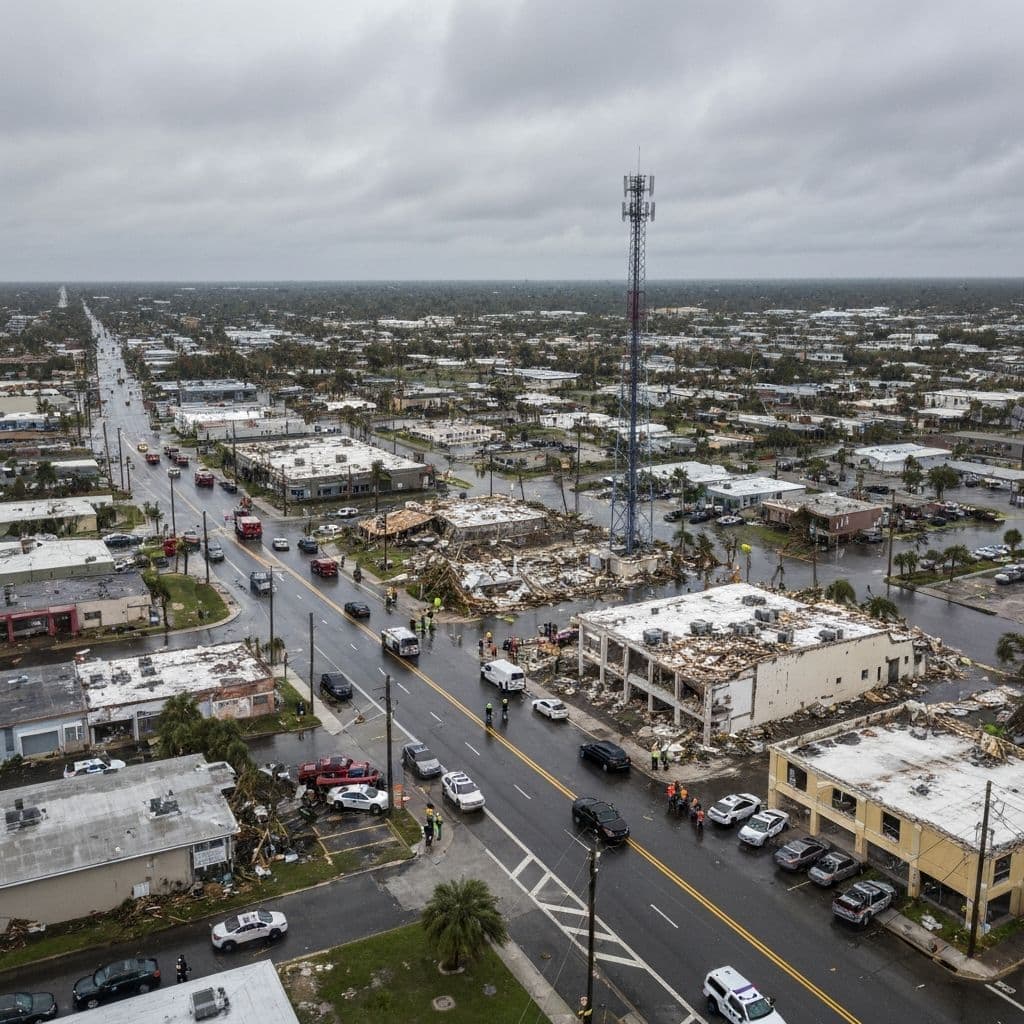
Category 4 hurricane with 150 mph winds struck southwest Florida September 28, 2022. FCC Communications Status Reports documented three PSAPs directly affected: Highlands County Sheriff and Sanibel Police successfully rerouted with location data preserved; DeSoto County Sheriff rerouted to administrative lines without location data.
- 1,096 cell sites out of service (7.7% of 14,188 total in disaster area)
- Root causes: power outages (68.5%), transport/backhaul issues (29.2%), physical damage (2.3%)
- Glades County lost 82.8% of cell coverage; DeSoto County lost 65.4%
- 457,343 wireline/cable subscribers lost service
Source: FCC Communications Status Report, Hurricane Ian (DOC-387791A1); Lee County Hurricane Ian After-Action Report (August 2023)
Relevance: Most comprehensive federal documentation of PSAP and cellular infrastructure failures. FCC data establishes power failure caused 68.5% of outages — validating generator backup as highest-priority hardening investment.

North Carolina Statewide Program
North Carolina established systematic PSAP grant program funding infrastructure hardening, consolidation, and equipment upgrades through the NC 911 Board. Statewide funding from service charges (~$32M annual for NG911 operations) enables competitive grants based on documented needs.
- Yancey County primary PSAP (replacing 1908 jail building): $4,897,637
- Watauga County + Boone consolidation: $2,700,000
- Cleveland County: $5,036,595
- Alamance County: $6,155,711
- FY2025: $21.0 million awarded to 14 PSAPs
- 2022: $16.3 million awarded to 11 PSAPs
Source: North Carolina Department of Information Technology press releases (2022-2025); NC.gov official grant announcements
Relevance: Demonstrates statewide systematic approach is feasible and sustainable. Provides cost benchmarks from multiple completed projects spanning rural and urban contexts.
Have More Questions?