




Implement a Dig-Once Policy
Strategic Brief
The United States spends nearly 150 billion annually on public highway and street construction, yet every trench closed without broadband conduit can make future fiber deployment 10 times more expensive than it needed to be.
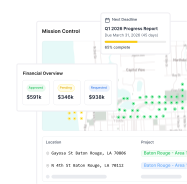
This play gives states a practical roadmap to require or incentivize telecommunications conduit installation during publicly funded excavation projects. Instead of paying for standalone trenching later, states can place empty conduit while the ground is already open, then track that asset through a GIS-based conduit inventory.
Investing in dig-once policy implementation helps state leaders:
- Reduce the largest cost driver in underground fiber deployment
- Install durable HDPE conduit with a 50+ year service life, enabling multiple fiber upgrade cycles without reopening the same corridor
- Build a GIS-based conduit asset inventory that supports broadband planning
- Move from notification-only coordination to mandatory installation with state or municipal ownership
- Create carrier-neutral conduit access frameworks through leases, in-kind trade agreements, provider registration, and transparent pricing terms
- Lower ISP market entry barriers by reducing excavation costs and making highway corridors more viable for competitive fiber deployment
This play results in a long-lived infrastructure asset that compounds in value with every construction season. For state leaders, dig-once is a practical way to stretch broadband dollars, reduce future deployment costs, strengthen planning capacity, and make every publicly funded trench work harder for the communities it serves.
The Opportunity
The Problem
The United States spends $148.5 billion annually on public highway and street construction. Every trench opened and closed without placing broadband conduit is an irreversible missed opportunity. Civil works — excavation, road cutting, trenching, backfill, and surface restoration — account for 60–90% of underground fiber deployment costs, according to converging estimates from FHWA, FCC, CTC Technology & Energy, the Fiber Broadband Association, and the Vanderbilt Policy Accelerator. When a state builds or rebuilds a highway and does not install conduit, it guarantees that any future fiber deployment along that corridor will require a separate, standalone excavation at $18 per foot median cost — or $96,000 per mile. Adding conduit to the open trench would have cost $1 per foot in materials
The scale of the waste is staggering. With $206 billion in annual state and local highway spending (56% on capital projects), tens of thousands of miles of road are opened and closed each year without conduit. GAO found that building broadband after a road is built costs "10 times more" than installing conduit during initial construction. Yet only six states currently mandate conduit installation. The remaining 38–44 states have either no dig-once policy or only notification-based frameworks with limited demonstrated impact.
The communities most harmed are rural. Rural fiber-to-the-home deployment costs $3,000–$10,000 per passing versus $700–$1,500 in urban areas, and the premium is driven almost entirely by excavation over longer distances.
The Context
Dig-once occupies a unique position in the current policy environment: it is the most proven, least controversial, and most underdeployed infrastructure policy available to state broadband directors.
The bipartisan eligible-use consensus forming around remaining BEAD funds explicitly includes conduit systems, manholes, in-line amplifier facilities, and related infrastructure, as well as resources for tools, personnel, and systems to improve permitting efficiency for broadband deployment. Dig-once program administration — conduit asset tracking, GIS mapping, provider notification systems, inter-agency coordination — maps cleanly onto these categories.
The FHWA 2021 Final Rule (23 CFR Part 645, Subpart C) already requires all 52 U.S. jurisdictions to designate broadband utility coordinators, register broadband infrastructure entities, and develop strategies to minimize repeated excavations. A 2026 GAO survey found 46 of 52 jurisdictions broadly coordinating — but the rule explicitly does not mandate conduit installation. States that move from notification to mandatory installation are building on existing federal infrastructure, not creating new bureaucracy.
Federal surface transportation reauthorization is due by September 30, 2026. Congress has considered standalone dig-once legislation in every session since 2009, with consistent bipartisan House support. States that have already implemented mandatory dig-once are positioned as models.
For states with remaining CPF balances, conduit installation during active construction projects is a strong candidate — capital-intensive, near-term deployable, and directly supporting broadband infrastructure goals.
The Demand Signal
The demand signal for dig-once is unmistakable and accelerating. GAO has studied dig-once twice (2012 and 2026), selecting Utah for an on-site case study visit due to its model status. The 2026 report documented 46 of 52 jurisdictions coordinating broadband with highway construction — but found that the rule's effects on broadband deployment "were not well known," indicating demand for stronger implementation frameworks.
At the state level, Arizona expanded its program in 2021 (HB 2596) and entered a 25-year public-private partnership for conduit management in 2024–25. Colorado issued a new executive order (D 2022 009) and Transportation Commission resolution (December 2023). Illinois strengthened its original 2009 law with SB 1438 in 2023. West Virginia, Maine, Georgia, and North Carolina have all enacted dig-once frameworks since 2018.
The Vanderbilt Policy Accelerator published a comprehensive dig-once analysis in December 2025, finding that states with strong installation requirements generally have higher fiber coverage rates. The EU's escalation from the Broadband Cost Reduction Directive (2014) to the directly applicable Gigabit Infrastructure Act (2024) demonstrates international regulatory trajectory toward mandatory conduit sharing. The UK's Physical Infrastructure Access regime — 170+ companies, 193,000+ km of duct, 1 million+ additional customers connected — shows the scale of market transformation possible.
Fifteen years of bipartisan federal legislative attempts, state-level acceleration, international regulatory escalation, and consistent industry cost documentation all point in the same direction: dig-once is moving from best practice to baseline expectation.
The Play in Practice
A dig-once program installs empty telecommunications conduit during any publicly funded excavation that opens the ground to a depth of 18 inches or more. The physical infrastructure is standardized, low-cost, and well-understood.
The standard installation places 3–4 HDPE (high-density polyethylene) conduit pipes simultaneously: typically one 4-inch conduit housing 3×1-inch innerducts (fiber, data, spare). HDPE conduit meets ASTM F2160 specifications with minimum SDR 11 rating (or SDR 9 for directional drilling applications). Fill ratio must not exceed 70%. AASHTO R 63-13 (2017) governs HDPE conduit in highway right-of-way applications.
Burial depth follows NEC Table 300.5: minimum 18 inches for PVC conduit, 24 inches when sharing a trench with power conduit. Minimum 12-inch separation from other utility conduits. Conduit sweeps require minimum 15-foot radius bends with maximum 180 degrees cumulative between pull points.
Handholes (access points) are installed at intervals not exceeding 400 feet. Standard handhole dimensions are approximately 24"×36"×26", with lids meeting AASHTO H-20 load ratings for vehicular traffic areas. Pull tape of minimum 2,500 pounds tensile strength is installed at placement.
Material costs are minimal: HDPE conduit runs $0.70–$1.50 per foot retail. Total installed cost — including materials, handholes, and incremental labor — ranges from $25,000 to $95,000 per mile, representing less than 1% of total road construction project budgets.
HDPE conduit has a documented service life of 50+ years, while fiber optic cable typically lasts 25–30 years. Conduit thus outlasts the fiber it houses, enabling multiple technology upgrade cycles without additional excavation.
The program also requires a GIS-based conduit asset management system integrating with 811 "call before you dig" systems and DOT project planning.
Implementation Approach
Audit existing coordination infrastructure and policy gaps
The state broadband office inventories the current dig-once posture: existing law/EO/DOT policy, notification-only vs. mandatory, FHWA broadband utility coordinator status, and existing conduit assets. The office reviews FHWA 2021 Final Rule compliance, identifies gaps, and assesses the DOT's excavation notification process. This audit takes 30–60 days and produces the gap analysis driving the policy design in Step 2.
Design and adopt mandatory dig-once policy
Based on the gap analysis, the broadband office drafts a mandatory conduit installation policy. The instrument depends on context: executive order (1–3 months), DOT rulemaking (3–6 months), or legislation (one session). Model resources are available from the FTTH Council ("Dig Smart"), Dura-Line, and Vanderbilt Policy Accelerator. The policy specifies: project triggers, conduit specifications (ASTM F2160, 4-inch HDPE with innerducts), ownership, carrier-neutral access terms, and inter-agency coordination. The broadband office and DOT develop a joint MOU.
Build conduit asset inventory and GIS tracking system
The broadband office procures a GIS-based conduit asset management system recording GPS coordinates, depth, type, diameter, capacity, ownership, and condition. The system integrates with the state 811 database and DOT project planning. A provider-facing portal shows available conduit capacity overlaid with planned construction. Development and initial data population: 6–12 months.

Unlock Your Free BEAD II Playbook
Benefits
Immediate
- Conduit installed in first construction season at incremental costs <1% of project budgets, creating immediate broadband infrastructure inventory.
- GIS-based conduit asset inventory established, giving broadband office and providers a shared map of available infrastructure.
- DOT-broadband office coordination formalized through MOU, establishing institutional relationships that outlast any single grant program.
- Provider notification and engagement launched, creating a pipeline of ISP interest in conduit access.
- State positioned as dig-once leader, strengthening competitiveness for federal broadband programs and private investment.
Strategic
- Cumulative conduit inventory grows with every construction season — each year's investment compounds as more corridors become fiber-ready at marginal cost.
- Future fiber deployment costs reduced 60–90% along conduit corridors, making broadband viable in rural communities where standalone economics are prohibitive.
- ISP market entry barriers lowered, increasing provider competition in markets currently served by one or zero broadband providers.
- Conduit lease revenue offsets program administration costs, potentially self-sustaining within 3–5 years.
- Institutional capacity — GIS mapping, provider coordination, inter-agency coordination — transfers to other broadband programs, strengthening the broadband office's long-term role.
Cascading Effects
First-Order Effects
Empty broadband conduit is installed in every qualifying state-funded excavation project.
The state builds a georeferenced inventory of conduit assets with published capacity data.
DOTs integrate conduit installation into standard project design and construction management.
Telecommunications providers receive structured notification of conduit availability and standardized access terms.
The incremental cost — $25,000–$95,000 per mile — is absorbed within existing road construction budgets at less than 1% of total project cost.
Second-Order Effects
Affordability: Eliminating 60–90% of underground deployment costs reduces the capital threshold for ISP market entry, making rural communities with per-passing costs of $3,000–$10,000 economically viable for fiber deployment; lower deployment costs drive consumer price competition — Utah's 62.5% fiber coverage versus the 49% national average reflects the aggregate market effect.
Competition: Pre-installed conduit in public right-of-way removes the civil works barrier protecting incumbent monopolies, enabling smaller ISPs to deploy fiber without excavation capital; Sonic.net's competitive network built on Brentwood city conduit and the UK's Physical Infrastructure Access regime — with 170+ companies using regulated duct access — demonstrate the scale of transformation possible.
Economic Development: Fiber-ready highway corridors create the latency environment needed to attract data-sensitive industries, remote work, telemedicine, precision agriculture, and AI inference workloads; states with documented conduit inventories gain a documented advantage over those requiring greenfield construction in site selector evaluations.
Resilience: Pre-installed conduit enables cable to be air-jetted through existing infrastructure without excavation, compressing restoration timelines from weeks to days; Utah built 167 miles of middle-mile fiber in six months using pre-existing conduit, and conduit corridors along multiple highway routes provide the physical substrate for redundant, diverse fiber paths.
Workforce Development: Dig-once accelerates fiber deployment projects that generate substantial construction employment, allowing the same workforce to deploy more fiber per dollar by reducing the excavation bottleneck; states pairing dig-once with fiber technician training programs create a compounding effect — cheaper deployment plus trained workers equals faster buildout against a projected national shortfall of 178,000–205,000 workers.
Unlock Your Free BEAD II Playbook
Risks & Mitigations
Unlock Your Free BEAD II Playbook
Real-World Case Files
Documented incidents and programs providing cost benchmarks, failure analysis, and proven implementation models.
Have More Questions?