


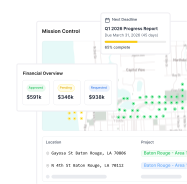


Turn Libraries into Points of Care
Strategic Brief
Community anchor institutions are critical, locally rooted organizations like schools, libraries, and public safety entities that facilitate essential services for communities. Public libraries offer a high-impact entry point: sited in nearly every county, trusted by residents who avoid government offices, and recently upgraded with BEAD-funded broadband. The same model extends to other anchor institutions where the access pattern holds, including schools, healthcare providers, and similar locally rooted organizations.
Public libraries received broadband under BEAD and predecessor programs, but that investment stops at the router. Approximately 99 million Americans live in federally designated primary care shortage areas, and rural hospital closures leave affected residents traveling 20-30 miles for comparable specialty care. The library is often the nearest institution with reliable broadband, but the open floor plan, shared computers, and ambient noise make it unusable for a telehealth appointment, a benefits intake interview, or a workforce training session.
Turning community anchor institutions into critical communications centers helps state leaders fix that problem.
This play deploys private, ADA-accessible, soundproofed service booths inside public libraries and other anchor institutions. Each booth connects residents to telehealth, workforce training, and government benefits enrollment through a single guided touchscreen interface. Each session generates automatic compliance documentation for Medicaid work-requirement hours, workforce training completions, and telehealth utilization without manual staff input.
Investing in a community anchor institution portal fleet helps state leaders:
- Identify the sites where rural and low-income residents have broadband nearby but cannot use it for the services they need
- Deploy private booths that connect residents to physicians, job trainers, and benefits navigators without leaving their county
- Generate automated session-by-session compliance documentation for Medicaid work requirements and workforce training programs
- Demonstrate documented utilization returns on existing BEAD library connectivity investments to governors, legislatures, and federal auditors
- Stack BEAD non-deployment funds (pending NTIA guidance), CPF balances, state broadband appropriations, E-rate Category 2, and LSTA grants
States get a service delivery layer that converts existing broadband at community anchor institutions into measurable constituent outcomes, supplies audit-ready compliance data to state Medicaid and workforce agencies, reaches residents who cannot access services at home or at distant providers, and produces utilization documentation that shapes the next round of community anchor institution investment decisions.
The Opportunity
The Problem
This play addresses three simultaneous access failures: telehealth, workforce training, and benefits enrollment. Importantly, broadband alone cannot solve these intersectional challenges without purpose-built private access infrastructure
Approximately 99 million Americans live in federally designated primary care Health Professional Shortage Areas (HRSA HPSA data, 2024). A 2023 GAO report found that rural hospital closures leave affected residents traveling 20–30 additional miles on average to reach comparable specialty care (GAO-23-105765). For these residents, the library is the nearest institution with reliable broadband — but the open floor plan, shared computers, and ambient noise make it unusable for a telehealth appointment, a benefits intake interview, or a workforce training session that requires sustained attention and privacy.
The stakes are documented. The first operational Medicaid work requirement program — Arkansas in 2018 — lost 18,164 beneficiaries in six months. A study published in the New England Journal of Medicine found that coverage losses were driven primarily by failure to navigate compliance documentation systems, not failure to actually perform qualifying work activities (Sommers et al., NEJM 381(11), 2019). 96.5% of affected beneficiaries were already working, already exempt, or faced documentation barriers they could not overcome. Compliance infrastructure is not an administrative convenience. Its absence is a documented public health failure that stripped coverage from people who were entitled to keep it.
The Context
Three simultaneous policy pressures converge on this play. First, states with active or pending Medicaid work requirements face compliance documentation mandates for which no purpose-built physical infrastructure exists, the Arkansas NEJM study documents precisely what happens when that infrastructure is absent. Second, state broadband offices that invested BEAD funds in library and CAI connectivity face growing pressure from governors and legislatures to demonstrate measurable utilization returns on that investment. Third, rural and low-income residents face persistent barriers to telehealth, workforce training, and benefits enrollment not because broadband is absent at their local library, but because the open floor plan makes it unusable for the services they need.
Service portals address all three pressures simultaneously: they convert existing connectivity investment into documented service delivery, generate the compliance and utilization data both state and federal agencies require, and provide the private access infrastructure that transforms broadband into usable healthcare, workforce, and benefits access. CPF balances with near-term expenditure deadlines and many state or federal funding at the intersection of technology and health which includes workforce development facilities and combination infrastructure projects… this is a play that states can design and fund now.
The Demand Signal
Three converging bodies of evidence document that the demand for private-access service delivery infrastructure at community anchor institutions is real, growing, and unmet by current CAI broadband investment.
First, the telehealth utilization gap. A 2023 peer-reviewed study published in the National Library of Medicine found that counties with the highest broadband availability had 47% higher telehealth utilization than those with the lowest but a separate JAMA Network Open study of 172,387 Wisconsin Medicaid beneficiaries found that telehealth disparities persisted even among patients with high-speed internet at home. Broadband connectivity alone does not produce telehealth utilization. The Kruse et al. systematic review of 45 studies identified private access space and not connection speed as the primary adoption barrier. Libraries upgraded by BEAD have the connection. They do not have the space.
Second, the HRSA shortage data quantifies the population with no alternative. HRSA identifies 99 million Americans in federally designated primary care Health Professional Shortage Areas. For these residents, the local library is frequently the only institution with reliable broadband within reasonable distance. Telehealth demand in shortage areas is documented and unmet. The infrastructure to use it at community access points is not.
Third, the Medicaid compliance deadline is now federal law. The One Big Beautiful Bill Act, signed July 4, 2025, mandates Medicaid work requirements for adults in the ACA expansion group beginning January 1, 2027; a requirement that applies to 43 states. Nebraska begins enforcement May 1, 2026. Montana on July 1, 2026. Iowa on December 1, 2026. Every state that expanded Medicaid must build compliance documentation infrastructure before the deadline or risk the outcome the Arkansas program documented: 18,164 people losing coverage in six months because the online reporting system failed them, not because they weren't working. The compliance infrastructure gap is no longer a policy experiment in a handful of states. It is a 43-state implementation problem with a hard deadline and no state has purpose-built the physical access points residents need to navigate it.
The Play in Practice
Each service portal is a freestanding, soundproofed booth approximately 4×4 feet in footprint, ADA-compliant in interior dimensions and approach path. States should plan for two unit configurations: a standard unit (ADA approach path and interior compliance) and a wheelchair-accessible variant (larger footprint, interior turning radius, height-adjustable interface); a minimum of 20% of any state fleet should be wheelchair-accessible units. For libraries or CAIs without available open floor space, an existing office or meeting room may substitute as the portal enclosure.
The exterior panel displays a QR code for walk-up booking and a status indicator (available / occupied / scheduled). The interior is equipped with a 27-inch medical-grade touchscreen display with adjustable height and tilt, a clinical-quality camera with 1080p resolution, noise-canceling directional microphone, a privacy screen film preventing external viewing, and a privacy lock controlled from inside. USB-C and standard AC power outlets support peripheral devices including blood pressure cuffs, pulse oximeters, and document scanners for sites that opt into peripheral health monitoring packages. All specifications are minimums; higher-performance equivalents are acceptable.
Minimum viable connection is 25/3 Mbps with latency under 150ms; optimal performance requires 100 Mbps symmetric with latency under 50ms. Booths do not require dedicated circuits and standard 20A outlets are sufficient. Electrical prep consists of verifying outlet availability within the booth's cable run, typically completed by a library maintenance staff member in under two hours.
The guided touchscreen interface presents three service modes: Telehealth (connecting to state-approved telemedicine platforms including Teladoc and state Medicaid telehealth networks), Workforce Training (linking to state workforce portal and approved training platforms), and Benefits Enrollment (linking to state and federal benefits systems including Medicaid, SNAP, and unemployment). The interface is designed for zero prior digital literacy: large buttons, plain language at a 6th-grade reading level, and step-by-step guided navigation. Language selection is available on the first screen.
A fleet management dashboard accessible to whomever is governing their use such as state broadband office and to CAI administrators provide real-time utilization data, session logs, compliance reporting outputs, and maintenance alerts for each unit. All session data is logged automatically, generating the audit trail for NTIA reporting, Medicaid work-requirement compliance documentation, and workforce program outcome reporting without requiring manual staff input.
Implementation Approach
Assess site readiness and execute CAI system agreements
Before issuing site readiness checklists, the state broadband office scores candidate libraries and CAIs using a selection rubric that weights: (1) distance from nearest workforce service point, (2) distance from nearest hospital or primary care facility, (3) ACS device ownership rates in the surrounding census tract, and (4) absence of alternative public broadband access points within 20 miles. Sites scoring highest on combined access desert and equity indicators are prioritized for the first deployment cohort.
The state broadband office issues a site readiness checklist to candidate CAI systems covering: verified broadband speed and latency (minimum 25/3 Mbps with latency under 150ms; 100 Mbps symmetric with latency under 50ms preferred); available floor space of at least 5×5 feet (standard unit) or 8×8 feet (wheelchair-accessible unit) with accessible pathway; standard 20A outlet within cable reach; and CAI system willingness to execute the MOU.
Additional site assessment items required: (a) small-footprint flag in libraries or CAIs without adequate open floor space routed to repurposed office or meeting room deployment; (b) wheelchair-accessible unit required where sites needing accessible unit routed to 8×8 foot specification; (c) Cat 8 Ethernet run confirmed to proposed portal location in sites requiring Wi-Fi fallback flagged for additional review; (d) dedicated or reserved bandwidth confirmed or documented excess capacity sufficient to guarantee portal performance during peak hours.
Site assessments are completed by CAI staff using the checklist — no on-site visit from the broadband office is required for standard installations. The broadband office reviews completed checklists and executes MOUs with qualifying CAI systems.
Target: Week 1, all site agreements executed.
Ship portal units and prepare electrical and broadband connections at each site
Portal units ship from the vendor directly to each CAI location via freight carrier. Library maintenance staff confirms outlet availability and clears the installation footprint. The state broadband office sends configuration credentials to the vendor's installation team. Broadband speed tests are run at each site and results logged in the fleet management system. Any sites falling below minimum speed thresholds are flagged for remediation before installation proceeds. Sites requiring new electrical or ethernet wiring should budget for contractor costs of $500–$5,000 per site depending on run length and local labor rates; include this as a line item in the subgrant award.
Target: Week 2, units in transit; site prep complete.
Install units, configure network connections, and verify system functionality
Each booth connects via Cat 8 Ethernet hardwired to the library's broadband infrastructure; dedicated Wi-Fi is acceptable only where hardwired connection is physically impossible. Vendor installation teams complete physical placement and network configuration at each site in under 24 hours per unit. Configuration includes connecting to the fleet management dashboard, activating the compliance reporting feed, and confirming connectivity to all three service platforms (telehealth, workforce training, benefits enrollment). The broadband office conducts a remote functional test of each installed unit before sign-off. ADA compliance is verified at time of installation.
Target: Week 3, all units installed and network-confirmed.

Unlock Your Free BEAD II Playbook
Benefits
Immediate
- Rural and low-income residents gain private, bookable access to telehealth providers, job trainers, and benefits navigators at their local library or CAI without travel, without account creation, without prior digital literacy.
- Medicaid beneficiaries subject to work requirements log compliance hours through automated documentation, eliminating the paperwork barrier that drove 18,164 Arkansans off coverage in 2018.
- Workforce training completions at CAI sites are logged against state program goals, producing federal-reportable outcome data for workforce boards and agencies.
- Partner agencies such as state Medicaid, workforce boards, emergency management gain a shared real-time data feed on service access patterns, reducing interagency friction and improving coordination across distributed service delivery sites.
- Library and CAI directors gain documented evidence of patron service delivery that strengthens their case to local government funders for sustained facility investment.
Strategic
- Documented outcome dataset builds the case for program expansion, additional sites, and state appropriation support at 18 months.
- Compliance reporting infrastructure becomes a template for other state programs requiring activity documentation at distributed sites.
- Rural residents in the fleet counties develop familiarity with telehealth and online service interfaces, reducing cold-start friction for home broadband adoption when it becomes available.
- State broadband office is positioned as the institutional coordinator for distributed service delivery infrastructure — not merely a BEAD administrator.
- Fleet utilization data provides the geospatial demand signal for future CAI investment decisions.
Cascading Effects
First-Order Effects
Rural residents in CAI service areas access a physician, benefits navigator, or job trainer without leaving their county.
Medicaid beneficiaries subject to work requirements log compliance hours through a system that generates automatic documentation — eliminating the paperwork barrier that drove 18,164 Arkansans off coverage in 2018.
Workforce training completions at CAI sites are logged against state program goals, producing federal-reportable outcome data.
CAI broadband upgrades funded by BEAD produce documented, session-level utilization returns.
Medicaid, workforce agencies, emergency management, and partner service providers gain a shared real-time data feed that reduces interagency friction and improves coordination across distributed service delivery sites.
The state broadband office maintains the shared data infrastructure in a facilitative role — providing the platform through which partner agencies access the coordination data, without positioning itself as the primary consumer.
Second-Order Effects
Rural residents avoid the transportation costs — fuel, time, lost wages — associated with traveling 20–30 additional miles to reach specialty care or in-person benefits offices.
For a household making one specialty care visit per month, avoided travel costs represent $600–$1,200 per year at $0.67/mile.
State Medicaid programs avoid the administrative overhead of manual compliance tracking, which GAO documented as a significant cost driver in early work requirement implementations.
Portals do not directly create market competition, but they generate the utilization data that demonstrates rural demand for digital services — reducing the information asymmetry that leads commercial providers to underestimate rural market viability. Counties with documented high portal utilization become stronger candidates for private broadband investment in the next procurement cycle.
Portals are not resilience infrastructure as designed. They require AC power and active broadband. However, the fleet management dashboard creates a real-time map of CAI connectivity status across the state — which has secondary value for emergency management planning. A director who knows which CAI sites have confirmed broadband and which are offline during an event has better situational awareness for DRC siting decisions.
Workforce training completions logged through portal sessions contribute to state workforce development metrics. CAI staff who manage the fleet scheduling system develop basic digital infrastructure management skills. Over 24 months, portal-adjacent workforce effects compound: residents who complete initial training through a portal session are more likely to pursue advanced credentials through online platforms.
Unlock Your Free BEAD II Playbook
Risks & Mitigations
Unlock Your Free BEAD II Playbook
Real-World Case Files
Documented incidents and programs providing cost benchmarks, failure analysis, and proven implementation models.
Have More Questions?