




Turn Trusted Institutions into Points of Care and Opportunity
Strategic Brief
Community anchor institutions are already at the center of community life. Libraries, schools, health facilities, workforce centers, public safety facilities, tribal organizations, and other trusted local institutions are places people already know and use. Many also have something residents may not have at home: reliable connectivity.
Billions of dollars have gone toward connecting these institutions. But connectivity alone does not make them usable points of access for healthcare, workforce services, education, or benefits. Approximately 99 million Americans live in federally designated primary care shortage areas, and rural hospital closures leave affected residents traveling 20-30 miles for comparable specialty care. At the same time, millions of people live near a connected school, library, health facility, workforce center, or other community institution. What is often missing is a private, accessible place inside those institutions where someone can actually use that connection for a doctor’s appointment, job interview, training session, or benefits appointment.
States can close that gap by turning trusted institutions into points of care and opportunity.
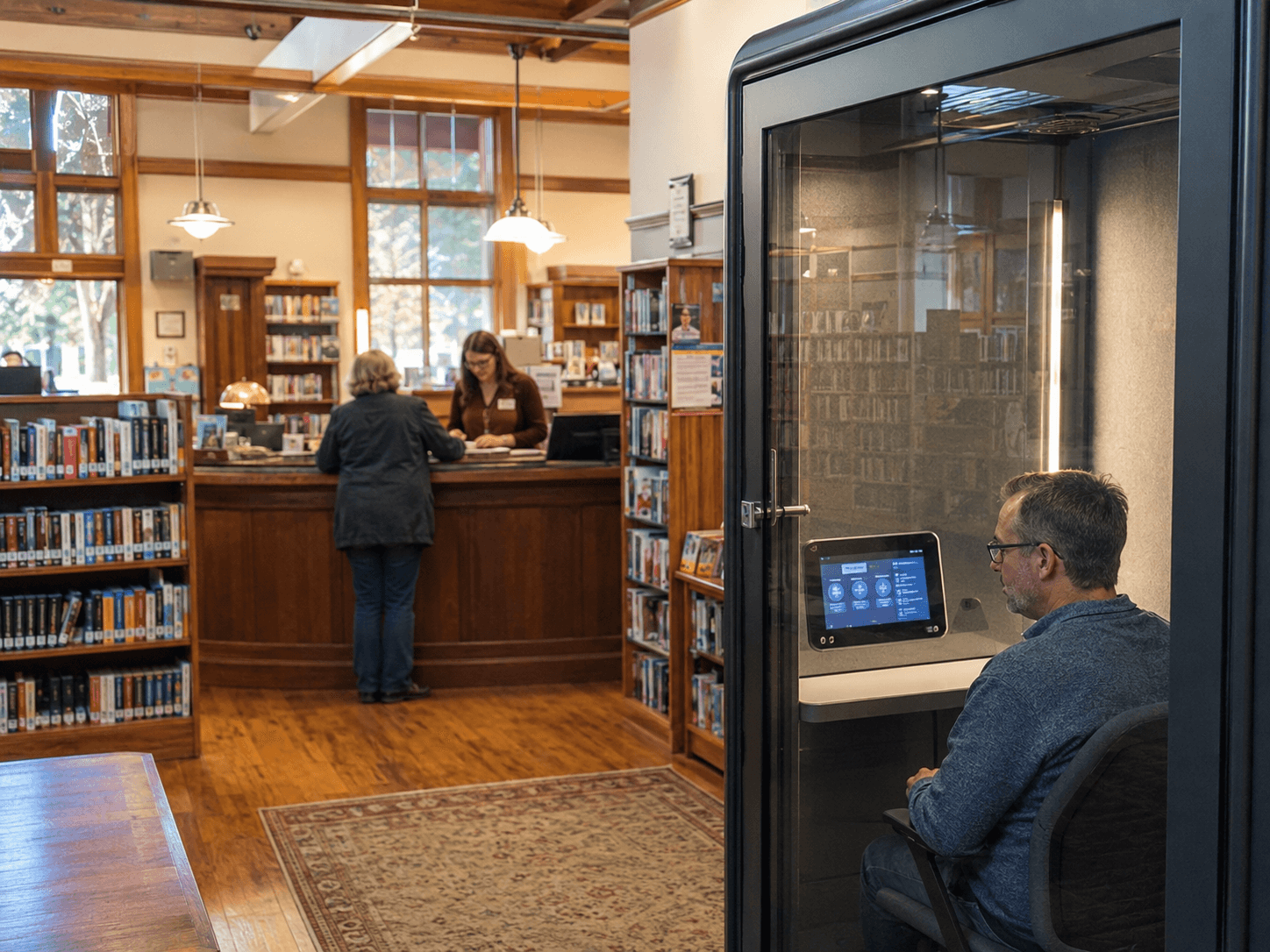
This play deploys private, ADA-accessible, acoustically private Portals inside existing anchor institutions. Portals give residents a dedicated place to connect with healthcare providers, training programs, employers, government services, and other remote resources.
Investing in a network of Portals across trusted institutions helps state leaders:
- Identify communities where essential services are far away but trusted, connected institutions already exist
- Bring private access to care, jobs, training, and government services closer to where people live
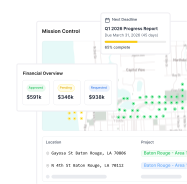
- Give agencies visibility into how the network is being used and where demand is growing
- Put existing connectivity and public infrastructure investments to work
- Combine eligible federal, state, and local funding sources to build a statewide access network
The result is straightforward: instead of building a new facility everywhere a service is missing, states can use infrastructure and institutions they already have to bring those services closer to residents.
The Opportunity
The Problem
For many rural families, the problem is no longer simply whether broadband exists somewhere nearby. The problem is whether they have a place where they can actually use it for something important.
Approximately 99 million Americans live in federally designated primary care Health Professional Shortage Areas (HRSA HPSA data, 2024). A 2023 GAO report found that rural hospital closures leave affected residents traveling 20–30 additional miles on average to reach comparable specialty care (GAO-23-105765).
Yet many of those same communities still have a school, library, health facility, workforce center, tribal facility, or other institution with reliable connectivity. Those institutions were not designed for private digital appointments. Open rooms, shared computers, noise, limited equipment, and lack of technical support can make a strong broadband connection effectively unusable for a confidential or high-stakes session.
The stakes are documented. The first operational Medicaid work requirement program — Arkansas in 2018 — lost 18,164 beneficiaries in six months. A study published in the New England Journal of Medicine found that coverage losses were driven primarily by failure to navigate compliance documentation systems, not failure to actually perform qualifying work activities (Sommers et al., NEJM 381(11), 2019). 96.5% of affected beneficiaries were already working, already exempt, or faced documentation barriers they could not overcome.
Access to a service is not meaningful if the process for reaching it is itself a barrier.
The Context
States have spent years connecting community institutions. They are also confronting growing pressure to improve rural healthcare access, strengthen workforce pipelines, help residents navigate government services, and show what public infrastructure investments actually deliver.
Those efforts do not have to happen separately. The same trusted institution can support multiple services if people have a private, connected place to access them. A Portal in a library might support a telehealth visit in the morning and a job interview in the afternoon. A Portal in a CareerTech, school, health facility, or tribal community center can serve the same role for a different population.
The common denominator is access infrastructure: use institutions that already exist, add the private space and technology people need, and connect those locations into a network that can support many services over time.
Why This Matters Now
The evidence points to the same problem from several directions: connectivity matters, but connectivity alone is not enough.
First, A 2023 peer-reviewed study published in the National Library of Medicine found that counties with the highest broadband availability had 47% higher telehealth utilization than those with the lowest but a separate JAMA Network Open study of 172,387 Wisconsin Medicaid beneficiaries found that telehealth disparities persisted even among patients with high-speed internet at home.
The connection is part of the answer. People also need the right place, equipment, privacy, and support to use it. A connected anchor institution can provide that foundation, but only if it is equipped for the service.
Second, the HRSA shortage data quantifies the population with no alternative. HRSA identifies 99 million Americans in federally designated primary care Health Professional Shortage Areas. In many of these communities, rebuilding a hospital, opening a new workforce center, or placing a specialist nearby is unrealistic. But the community may already have a connected institution capable of becoming a local access point.
Third,The One Big Beautiful Bill Act, signed July 4, 2025, mandates Medicaid work requirements for adults in the ACA expansion group beginning January 1, 2027.Whatever systems states build for compliance, residents will still need practical ways to access them. A statewide network of trusted access points gives states another way to help residents complete training, reach navigators, and use digital services without assuming everyone has the equipment, privacy, or connectivity to do so from home.
The Play in Practice
Ready Portals are private, connected rooms designed to deploy inside existing community institutions. States can place them wherever the need, connectivity, space, and local partnership make sense: libraries, schools, CareerTechs, health facilities, community colleges, tribal facilities, senior centers, community organizations, and other trusted institutions.
The network should include accessible configurations so people using wheelchairs and companions can use the Portal comfortably. Site selection should account for physical accessibility from the beginning rather than treating it as a later accommodation.
Inside, the Portal provides the video, audio, privacy, connectivity, and interface required for high-quality remote interaction. Depending on the program, Portals can also support peripherals and other equipment required for specific healthcare or service use cases.
Each site needs sufficient connectivity, power, floor space, and an accessible path to the Portal. Those requirements should be confirmed during site assessment before deployment.
Portals are designed as flexible access infrastructure rather than single-purpose telehealth booths. A state can use the same network to support telehealth, behavioral health, workforce programs, education, remote job interviews, benefits assistance, government services, and other services delivered remotely.
BOSS gives the organization managing the network one place to see Portal status, utilization, maintenance needs, and other operating information across the fleet. That makes a distributed network of access points manageable as infrastructure rather than a collection of standalone rooms.
Implementation Approach
Identify the right institutions
Start with the service gap, not the institution type. Map where residents have the greatest distance to healthcare, workforce services, education, government services, or reliable private connectivity. Then identify trusted institutions already serving those communities.
Candidate sites can include libraries, schools, CareerTechs, community colleges, rural health facilities, tribal facilities, senior centers, community organizations, and other locally trusted institutions. A statewide network does not need every Portal to sit in the same type of building.
The state or lead agency issues a site readiness checklist to covering: verified broadband speed and latency (minimum 25/3 Mbps with latency under 150ms; 100 Mbps symmetric with latency under 50ms preferred); available floor space of at least 5×5 feet (standard unit) or 8×8 feet (wheelchair-accessible unit) with accessible pathway; standard 20A outlet within cable reach; and local willingness to host and support the Portal.
The goal is to answer a few practical questions before a unit is assigned: Is this the right community? Is this the right institution? Is the space ready? Is the connection reliable? Can people reach and use the Portal comfortably?
Host institutions can complete an initial readiness assessment remotely, with field validation reserved for sites that require additional electrical, network, accessibility, or installation work.
Prepare sites and deploy Portals
Once sites are approved, complete any required electrical, network, or space preparation before delivery. Confirm network performance again during installation so a Portal does not arrive at a location that cannot support it.
Connect and verify the network
Connect each Portal to the host institution's network, enroll it in BOSS, and verify privacy, audio, video, connectivity, accessibility, and remote management before launch. Service integrations should reflect the programs the state or local partner actually intends to make available at that location.

Unlock Your Free Resiliency Playbook
Benefits
Immediate
- Residents gain a private, connected place close to home for care, job interviews, training, education, benefits assistance, and other essential services.
- States gain physical access points that can support residents navigating increasingly digital healthcare, workforce, and government systems.
- Workforce and education programs can reach people in communities that do not have a nearby training center or campus.
- Program leaders gain a clearer picture of where Portals are being used and where additional services or capacity may be needed.
- Host institutions gain another way to serve their communities without having to become healthcare providers, workforce agencies, or benefits offices themselves.
Strategic
- Utilization data helps states decide where to expand the network and which services communities need most.
- A common Portal network can support new programs over time without requiring a new physical access strategy for each one.
- Residents gain a trusted place to become more comfortable using remote services and digital tools.
- States turn connectivity investments into infrastructure people can use for real services.
- Demand across the Portal network helps inform future infrastructure and service investments.
Cascading Effects
First-Order Effects
Residents access physicians, counselors, employers, educators, navigators, and other remote services closer to home.
People who need to complete digital requirements have a private, connected place to do so.
Workforce and education programs gain new physical access points without building new campuses or offices.
Connectivity inside anchor institutions supports visible, measurable uses beyond basic internet access.
Agencies and service providers gain a common physical network through which they can reach communities.
The agency leading the deployment can manage that network centrally through BOSS while host institutions remain focused on serving their communities.
Second-Order Effects
Rural residents avoid the transportation costs associated with traveling 20–30 additional miles to reach specialty care or in-person benefits offices.
That can mean less fuel, less time away from work, fewer childcare arrangements, and fewer trips made solely because a service is unavailable nearby.
Utilization also makes demand visible. If a rural Portal consistently hosts behavioral health appointments, training sessions, or other remote services, states and providers have better evidence of what that community actually needs.
Because Portals depend on power and connectivity, they should not be described as standalone resilience infrastructure. But managing them as a fleet can give states useful visibility into the operational status of connected anchor institutions across a deployment area.
Over time, the same physical network can support more providers, programs, and services without asking communities to build a new access point each time.
Unlock Your Free Resiliency Playbook
Risks & Mitigations
Unlock Your Free Resiliency Playbook
Real-World Case Files
Documented incidents and programs providing cost benchmarks, failure analysis, and proven implementation models.
Medicaid Work Requirements and Coverage Loss: Arkansas 2018
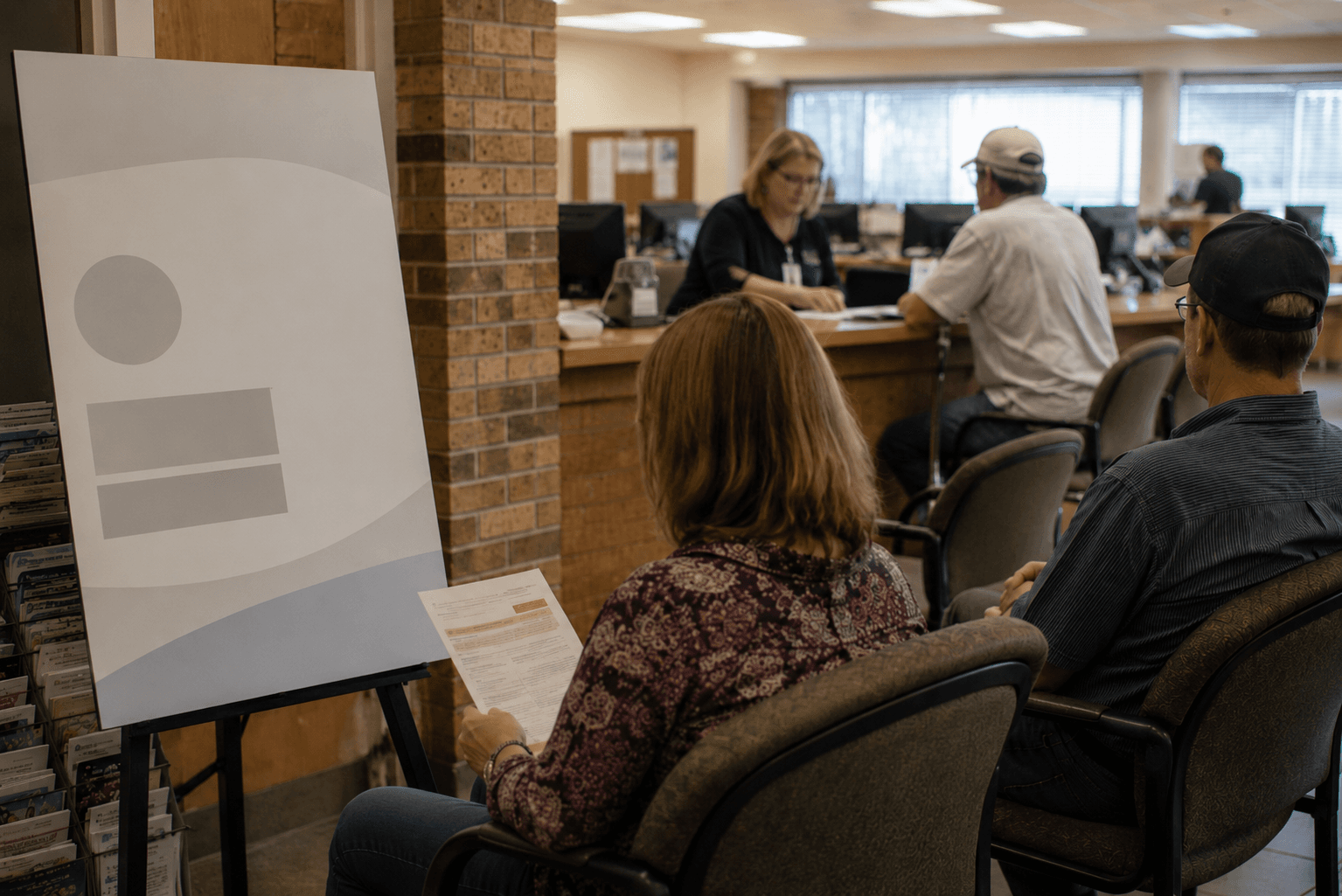
The first operational Medicaid work requirement — Arkansas in 2018 — terminated coverage for 18,164 beneficiaries in six months. A study published in the New England Journal of Medicine found that coverage losses were driven primarily by documentation barriers, not failure to perform qualifying activities. 96.5% of affected beneficiaries were working, exempt, or faced compliance documentation systems they could not navigate.
- 18,164 beneficiaries lost coverage in six months
- 96.5% were working, exempt, or faced documentation barriers — not non-compliant
- Coverage losses driven by inability to navigate online reporting systems
Source: Sommers, B.D. et al., 'Medicaid Work Requirements — Results from the First Year of Arkansas's Program,' New England Journal of Medicine, 381(11), 1073–1082, 2019. U.S. Government Accountability Office, 'Medicaid Work Requirements: CMS Needs to Ensure Adequate Oversight of Demonstration Projects,' GAO-20-49, 2020.
Relevance: Broadband-connected service portals matter for benefits access: eligibility systems fail when residents must navigate complex digital documentation alone, and automatic session-level compliance records can reduce preventable coverage loss.
Telehealth Adoption Research: Private Access Space as a Structural Barrier
A systematic review of telemedicine adoption across 45 studies identified lack of appropriate private access space as one of the primary barriers to telehealth adoption — not technology unfamiliarity, cost, or connectivity (Kruse et al., 2018). A separate randomized controlled trial at UNC Chapel Hill found patient comfort with telehealth was significantly higher in dedicated private settings compared to shared or home environments (Khairat et al., 2019). Together, these studies establish that the portal's privacy enclosure is the mechanism that converts broadband connectivity into usable telehealth access.
- 45-study systematic review identified private access space as a primary telehealth adoption barrier
- Randomized controlled trial confirmed statistically higher patient comfort in private settings
- Broadband alone does not produce telehealth utilization — the physical access environment is the binding constraint
Source: Kruse, C.S. et al., 'Evaluating barriers to adopting telemedicine worldwide: A systematic review,' Journal of Telemedicine and Telecare, 24(1), 2018. Khairat, S. et al., 'Assessment of Patient Comfort With Telehealth: Randomized Controlled Trial,' JMIR Medical Informatics, 7(1): e11919, 2019.
Relevance: Current library broadband alone is insufficient: without a private, soundproof, ADA-accessible space, connectivity does not reliably translate into usable care, training, or benefits services.
Have More Questions?