NTIA BEAD Performance Measures: Building Beyond the Baseline for Better Broadband

Entering the Post-Award Stage
State Broadband Offices (SBOs), you’ve been through a lot. Years of mapping battles, policy debates, planning requirements, and public scrutiny. Now, BEAD is entering the post-award stage, and the spotlight shifts squarely onto you.
The question is no longer whether funding will flow — it’s whether the networks built under your oversight will deliver for decades to come. NTIA’s September 2025 Performance Measures for BEAD Last-Mile Networks Policy Notice gives you a strong foundation. But what you do next will determine if BEAD becomes a generational success story or a cautionary tale.
A Strong Step Forward from NTIA
Give credit where it’s due: NTIA has put forward performance measures that are smarter, clearer, and stronger than those of past federal broadband programs. They do a few important things:
Require annual testing of BEAD-funded networks for speed, latency, and reliability.
Tests occur during a one-week annual “test window,” with tests run nightly from 6pm to midnight local time.
Speed tests: At least one per hour, with each test running a minimum of 15 seconds.
Latency tests: One test per minute during each testing hour (60 per hour). Packet loss results count and cannot be discarded.
Test servers: Measurements must be taken at, or through, an FCC-designated IXP, with no prioritization of test traffic.
Mandate random sampling across subscribers and technology types.
Providers can’t cherry-pick their best-performing connections.
Sample sizes: 5 tests if ≤50 subscribers, 10% of subscribers if 51–500, or 50 if >500.
Each technology and each committed speed tier must be tested separately.
Enforce the 80/80 measure.
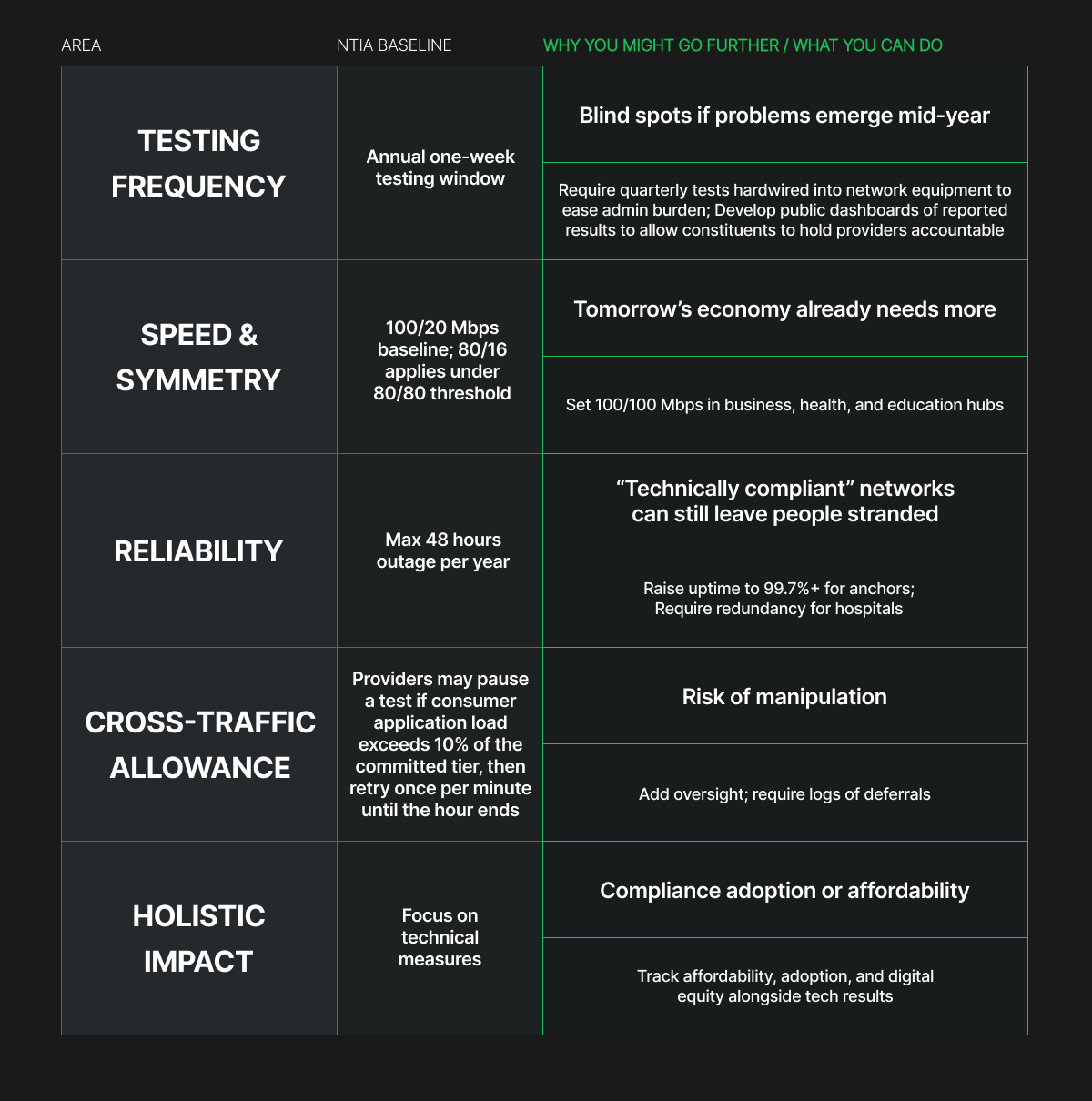
80% of tests must reach at least 80% of the committed speed tier (e.g., 80/16 under a 100/20 commitment).
Set firm thresholds for latency and reliability.
95% of latency tests must show ≤100 ms.
Networks can’t exceed 48 hours of outages per year (≈99.45% uptime). Outage time excludes scheduled maintenance and federally recognized disaster periods, and starts when a customer reports or the provider determines the outage.
Demand transparency.
Providers must document methods, publish aggregate results, retain raw data, and certify outcomes via a corporate officer.
Results must also be included in the first Semiannual Report (SAR) of each calendar year and prior to close-out.
Together, these measures reduce loopholes, cut down administrative burden, and give you tools that simply didn’t exist under past programs. They’re not the ceiling — but they are a stronger floor than we’ve seen before.
How BEAD Builds on Past Programs
You’re not the first broadband leaders to face this challenge. But you are the first with tools this strong. Compare BEAD’s framework with what came before:
BTOP (2009–2010): Oversight focused on build milestones and adoption, not service quality. → Lesson: building fast isn’t enough without verifying performance.
USDA ReConnect: Required minimum speed commitments (10/1, later 25/3 Mbps) with engineering sign-offs. → Lesson: static commitments can age poorly as demand grows.
FCC CAF II: Introduced structured testing (quarterly samples), but with thresholds too low (10/1 → 25/3 Mbps). → Lesson: testing matters, but weak baselines leave people behind.
FCC RDOF: Continued CAF II’s framework but stumbled on enforcement and questionable awards. → Lesson: without strict sampling and transparency, compliance data can mask underperformance.
BEAD raises the bar: starting at 100/20 Mbps minimum, enforcing tech-specific reporting, requiring verified testing, and empowering states with corrective action tools.
Where You Can Go Further
NTIA has given you the foundation. But the real legacy is yours to write. Federal performance measures prevent failure. State measures can ensure excellence.
Pitfalls to Watch For
Performance measures are only as good as their implementation. Watch for:
Sampling bias that hides weak service areas.
Cross-traffic exemptions that distort test results.
Latency blind spots that miss recurring issues.
Interpretation errors that confuse “minimum compliance” with “excellence.”
Incomplete separation of test results by technology or speed tier. Policy requires each technology and tier to be tested independently, but sloppy implementation could still blur the picture.
Your vigilance can close these gaps.
What Authority You Have
NTIA sets the performance measures, but you hold the levers:
You can strengthen requirements in subgrant agreements.
You cannot change the federal requirements (sample sizes, methods, test windows).
You can require corrective action or more frequent testing when providers fall short.
In short: NTIA has handed you the playbook. You decide if the game ends in a win.
What It Takes
Going beyond the baseline doesn’t need new federal law. It needs:
Legal authority to embed tougher requirements in subgrant agreements.
Resources for monitoring and enforcement.
Political will to resist pushback and keep the focus on taxpayers and communities.
Collaboration with peers and providers to create consistent, sustainable expectations.
Doing It Smarter, Not Harder
Stronger performance measures don’t have to mean more paperwork or heavier burdens. The reality is that testing and reporting can be done faster, more efficiently, and more reliably if states use modern tools to automate the process.
That’s exactly what platforms like ARC are designed for:
Automated testing and ingestion → network checks run continuously in the background, with results captured and submitted without manual effort.
Secure random sampling → cryptographic protocols validate that test locations are truly random, making audits both simple and defensible.
Real-time dashboards → one set of data can serve multiple audiences at once — state offices, providers, and communities — reducing duplicative reporting.
Predictive analytics → early warning indicators flag degradation patterns so issues can be fixed before they become compliance failures.
In other words: states don’t need to choose between rigor and practicality. With the right systems in place, performance measures can be trustworthy and low-burden at the same time — ensuring accountability without slowing deployment.
A Call to Collaborate
You don’t have to do this alone. Every state is grappling with the same questions: how to balance burden with rigor, how to close loopholes, how to protect investments.
 We’re convening a working group to tackle these issues together. Email standards@ready.net to join the conversation.
Make audit-ready your default state.
Post-award reporting, compliance oversight, and execution visibility in one structured system — built to hold as programs scale.