
Practical Framework for LEO Satellite Broadband Oversight

State broadband directors face a persistent challenge: In their role, they must ensure public investments deliver promised outcomes while also avoiding delays that prevent communities from accessing needed connectivity. LEO satellite broadband is emerging as the dominant technology for remote areas, making this challenge more complex. Orbital dynamics, shared capacity networks, and rapid deployment timelines construct new verification scenarios that traditional terrestrial oversight methods do not adequately address.
The Ready.net team and I are analyzing this new intersection of opportunity and accountability. We care about the outcome of the BEAD program and want to do everything we can to ensure efficient and effective use of public funds. LEO technology offers genuine opportunities to serve extremely remote locations, bolster emergency response, enhance network redundancy, and bridge coverage gaps while terrestrial infrastructure develops. Importantly, there are unique characteristics of orbital networks. Satellites travel at 17,000+ mph, promise dynamic capacity allocation, and have service areas spanning thousands of square miles… affordances that all require adapted verification approaches.
The ORBIT Framework Approach
Drawing from conversations with State Broadband teams across multiple BEAD implementations, I hear concerns about the management of satellite provider project oversight. State Broadband Offices (SBOs) and their teams express worry about how to monitor whether satellite dishes are being distributed and successfully installed at end-user premises, particularly given the remote nature of many BEAD-funded locations served by the technology. Stakeholders are also grappling with how to track and verify that reserved capacity commitments are being met over time, since traditional fiber, cable, or even fixed wireless monitoring approaches do not translate directly to satellite deployments. Additionally, there is confusion around tracking requirements for the up-to-three upgraded or replacement dishes allocated per BEAD-awarded location and whether the replacement cost is calculated per location or per subscriber. Each of these factors have significant compliance implications.
The technical challenge isn't insurmountable, but its coordination requirements are complex and states need practical tools to fulfill their oversight responsibilities without creating unnecessary administrative burden. We developed Ready’s open source ORBIT satellite monitoring framework as a baseline for the broader community to adopt or adapt. As a public benefit corporation, Ready’s mission centers on helping connect more families to better utilities at lower cost. This framework is part of our mission and serves the broader goal of bridging the digital divide. As I have grown closer to my colleagues, I assert that lowering barriers and reducing friction for clients and communities is simply who we are and what we care about.
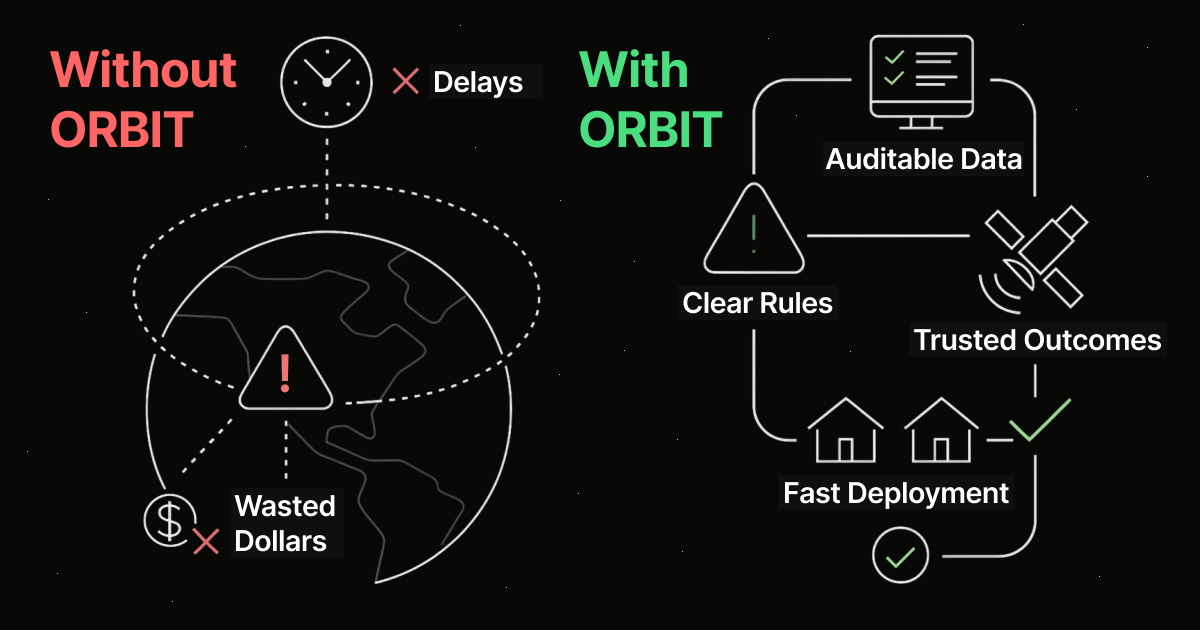
Together with a team of other subject matter experts, we developed a framework for risk mitigation that also serves to maximize opportunity for stakeholders. The ORBIT Framework (Orbital Reliability, Broadband Integrity, and Transparency) provides a three-layer verification system specifically designed for satellite broadband programs:
Layer 1: Service Availability Verification ensures LEO providers can deliver promised speeds and latency within specified timeframes, typically requiring 10-day service initiation capability across awarded locations.
Layer 2: Active Subscriber Verification confirms actual service adoption rather than just theoretical availability, preventing ghost subscriber schemes that have plagued other telecommunications subsidy programs.
Layer 3: Reserved Capacity Verification validates that providers maintain sufficient network capacity to serve awarded locations throughout the performance period, addressing concerns about network congestion during peak usage periods.
 Practical Implementation for BEAD LEO Capacity Subgrants
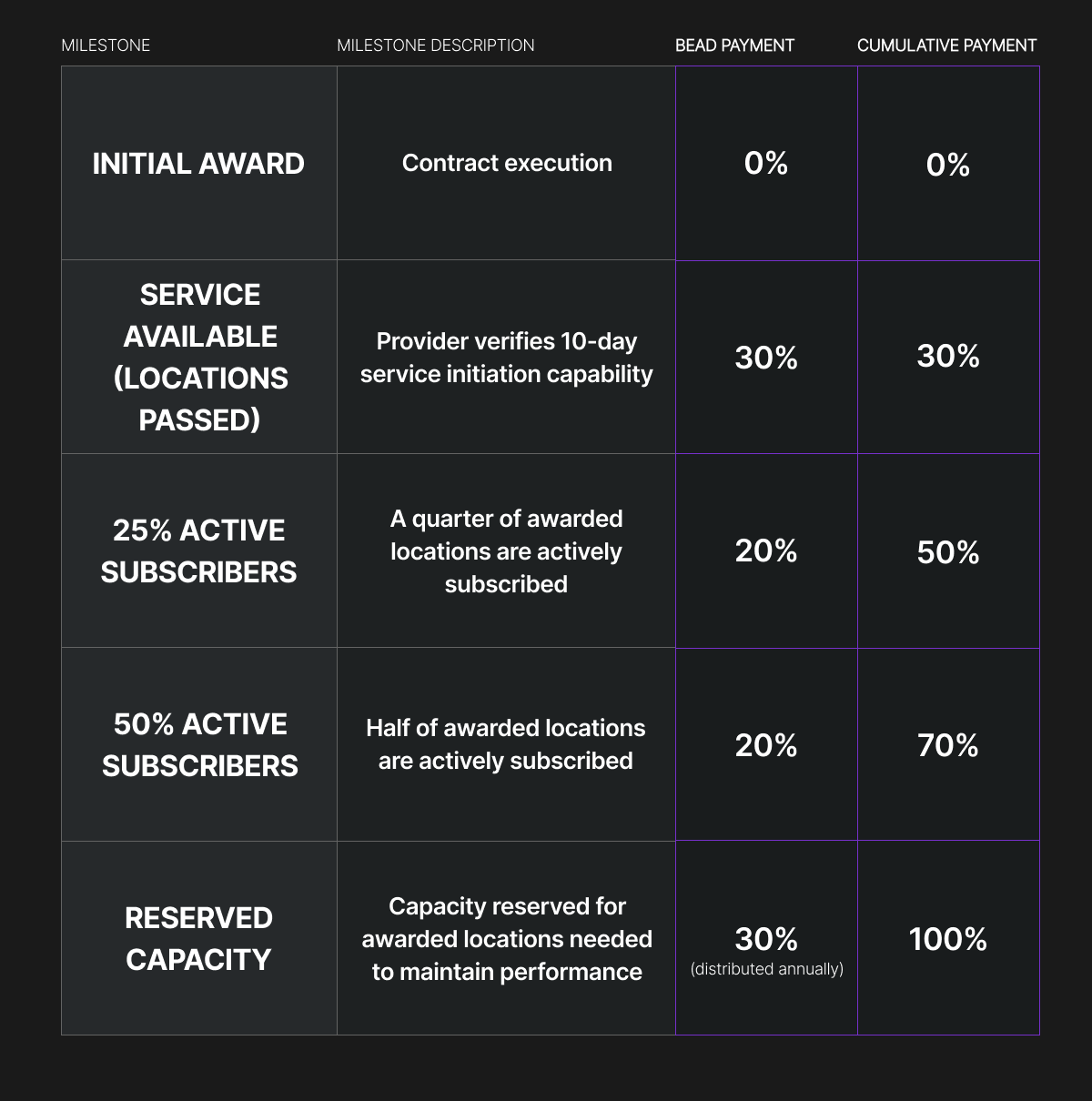
The ORBIT framework structures funding distribution in order to balance deployment acceleration alongside accountability by anchoring progress to milestone-based payments. Here's how ORBIT may work in practice:
 This structure addresses several practical concerns:
1) The substantial service availability payment enables providers to begin deployment immediately while creating accountability for actual capability;
2) Subscriber milestone payments incentivize genuine adoption rather than paper compliance;
3)The extended capacity reservation period—distributed as 3% annually over ten years—maintains provider incentives for continued service quality while matching the infrastructure-focused timeline of terrestrial deployments.
Adapting to Local Conditions
The ORBIT framework is designed to be nimble; states can adjust milestone percentages based on local market conditions and risk assessments. Also, rural areas with historically low broadband adoption could choose to weight service availability heavily, while regions with strong demand might prefer to emphasize subscriber milestones. The percentage-based approach in the ORBIT framework scales from small community projects to statewide deployments, maintaining consistent incentive structures across projects, large and small.
Verification Implementation
The technical aspects of the ORBIT framework focus on measurable outcomes rather than process compliance:
Service availability verification utilizes standardized speed testing during peak usage hours, geographically sampled across a subgrantee’s awarded area(s).
Subscriber status is confirmed using the National Verifier, strengthened with location validation to prevent address spoofing. Capacity verification tracks reserved bandwidth allocation through provider reporting validated by third-party monitoring systems.
Balancing Innovation with Accountability
LEO satellite broadband represents a transformative tool for closing coverage gaps, but its deployment through public funding necessitates appropriate safeguards. For stakeholders seeking to ensure the efficacy of BEAD funds, the challenge and promise of LEO lies not in the technology but in implementing verification systems that fuel rapid deployment and protect taxpayer investments. A scalable subgrant verification plan is the best insurance to realize promised LEO service delivery to beneficiary communities.
We designed the ORBIT Framework to acknowledge both LEO's strengths and limitations. Some locations awarded to LEO providers may ultimately prove unsuitable for satellite service due to topography, interference, or economic factors. In our research, we find that structuring disbursements with performance bonds, subscription milestones, and fund recovery mechanisms provides necessary capital protection while allowing providers the flexibility to optimize network resources.
Moving forward requires recognition that perfect solutions don't exist, but rather, understanding that practical progress remains achievable through strategic prioritization. States implementing LEO capacity subgrants need verification frameworks that match the technology's unique characteristics while maintaining the accountability standards that broadband programs require.
For state broadband directors evaluating LEO deployment options, the ORBIT framework provides a starting point for balancing deployment speed with program integrity—ensuring that communities counting on connectivity receive the reliable service they need while protecting the public investments that make it possible. We look forward to hearing your feedback and continuing to work with you all to solve these unique challenges.
Please stay tuned for a white paper on how and why Ready arrived at the ORBIT framework.
Make audit-ready your default state.
Post-award reporting, compliance oversight, and execution visibility in one structured system — built to hold as programs scale.