
7 Steps to Get Ready for the Next BEAD Challenge Process
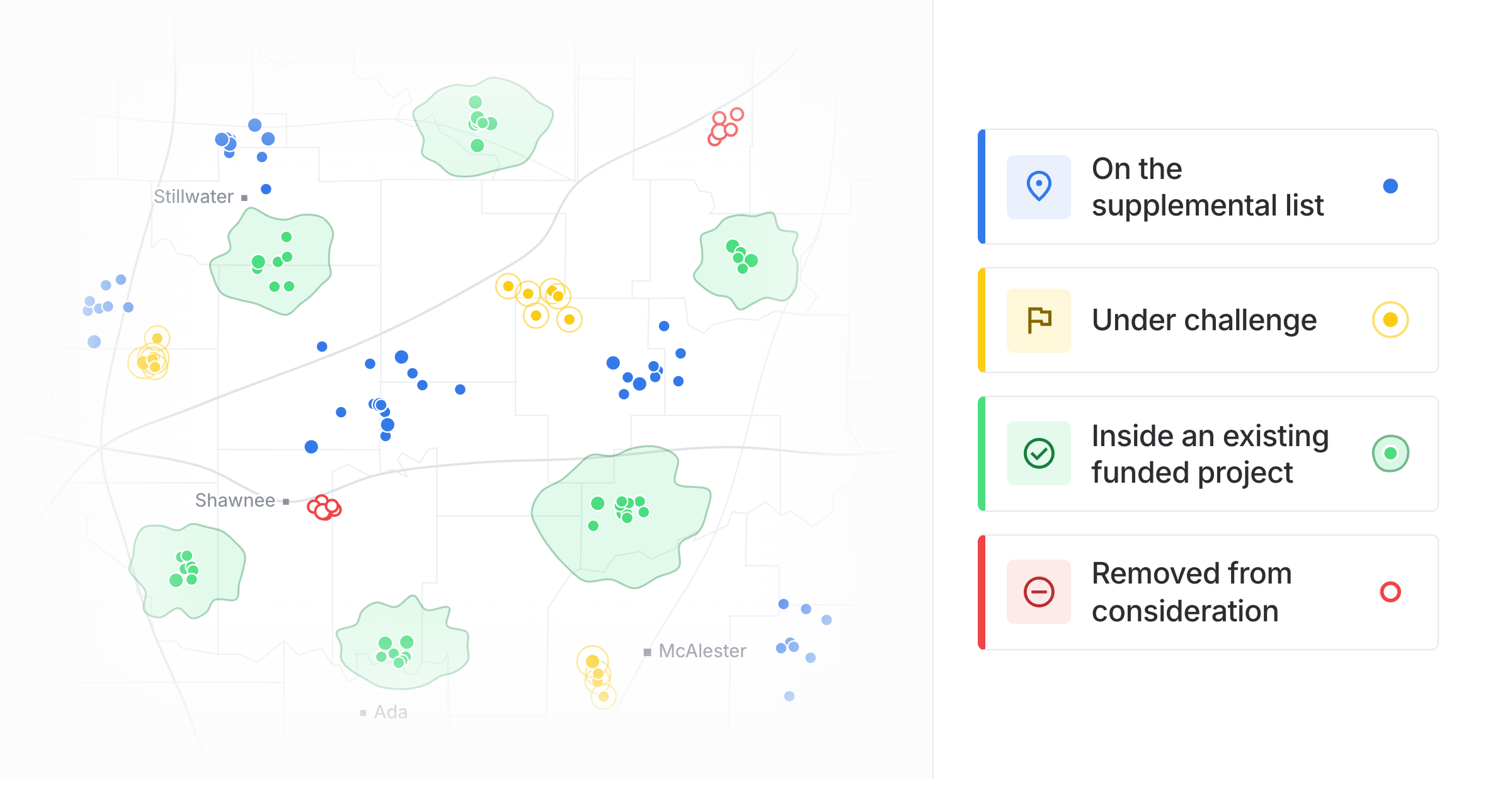
NTIA’s Supplemental Deployment Policy Notice requires every Eligible Entity to run an additional BEAD challenge and application round to reach remaining unserved locations. The remaining unserved locations resulted from defaults in federal or state broadband funding programs, such as RDOF, locations misreported as served in previous versions of the Broadband Data Collection (BDC) program, unfulfilled planned service challenges, and locations new to the Fabric.
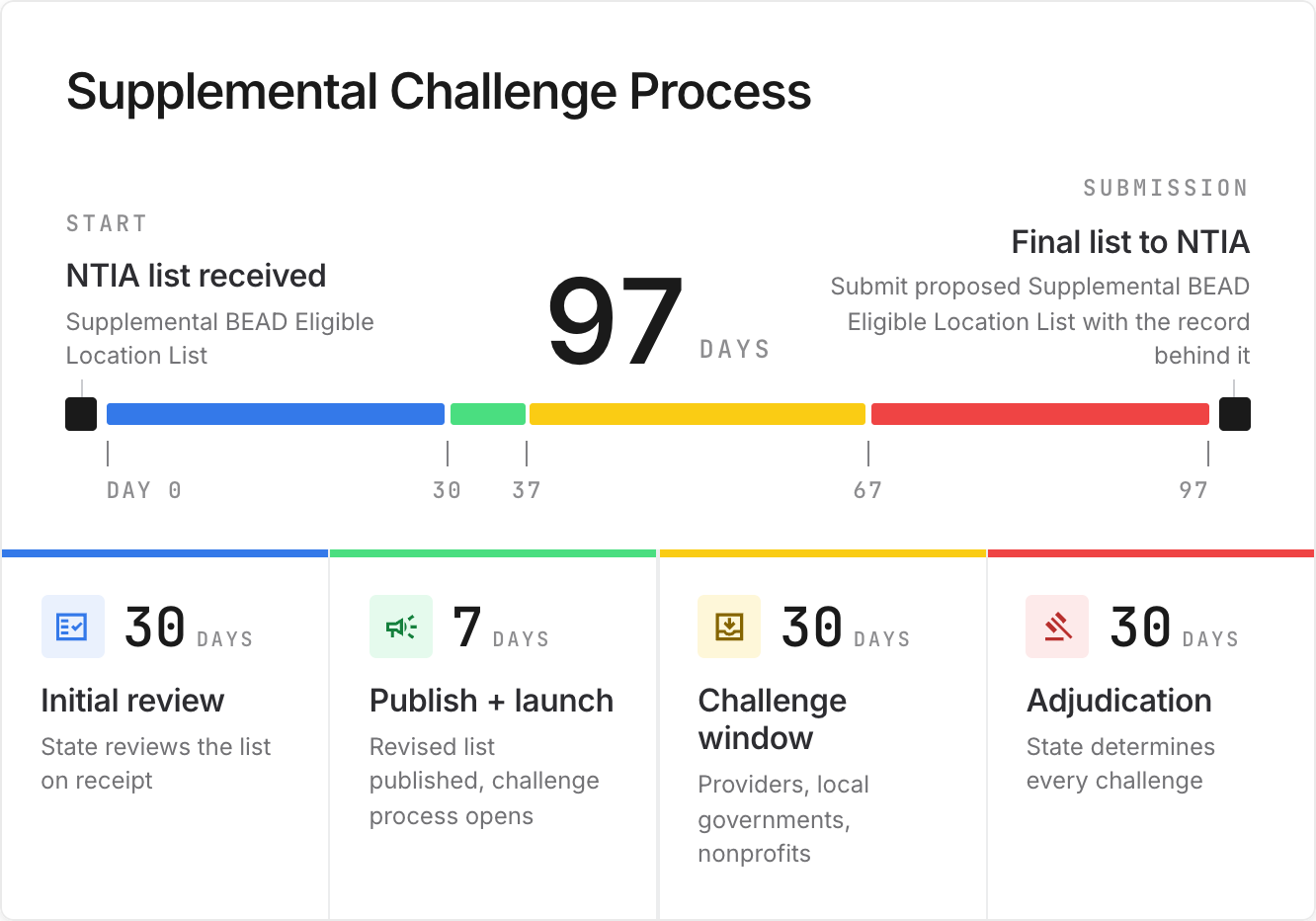
Whenever NTIA finalizes and delivers the Supplemental BEAD Eligible Location List, the process kicks off:
NTIA then reviews the final list and sets a funding cap, and the state has 90 days to run a second Benefit of the Bargain round and submit a Supplemental Deployment Plan.
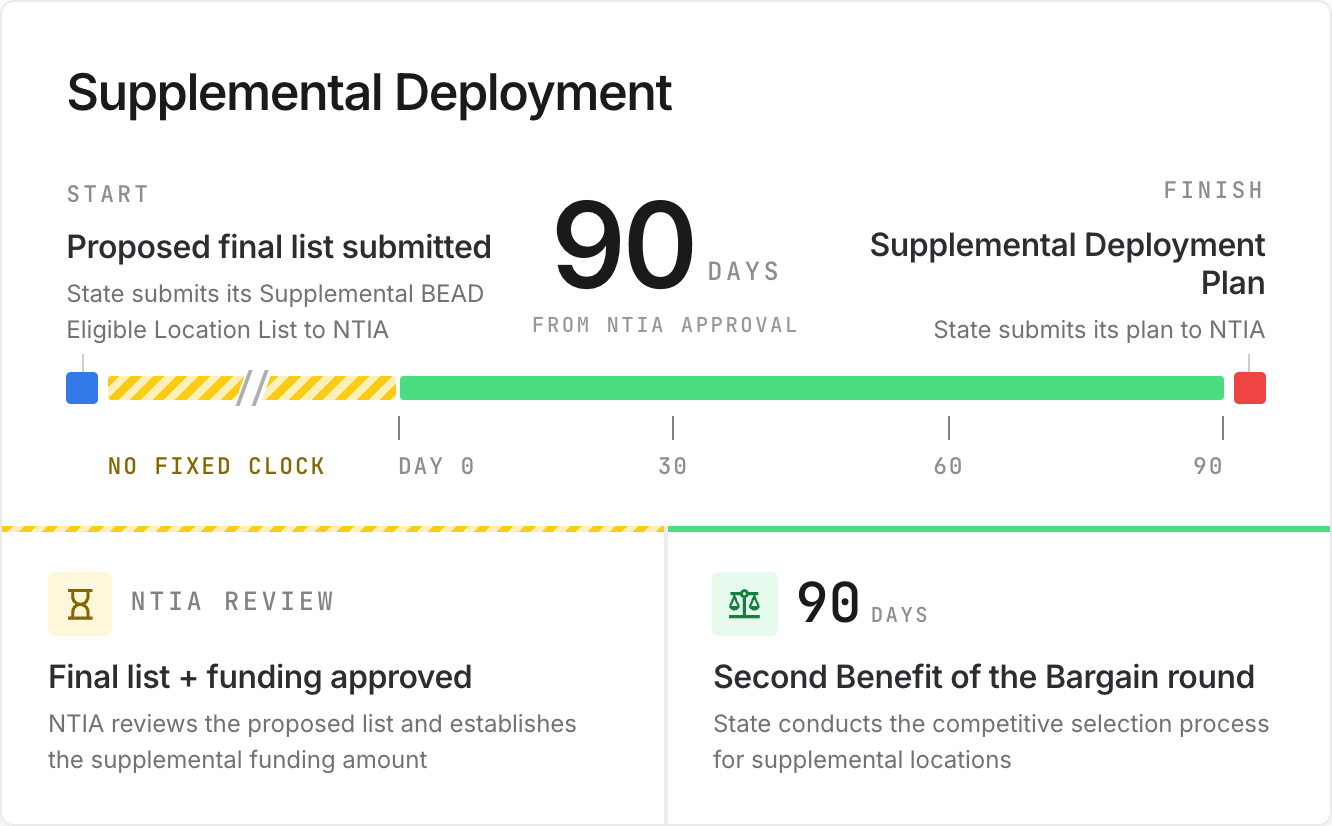
The full scope is roughly six months of sequenced, clocked work, arriving on top of subgrantee agreements, environmental and permitting reviews, milestone monitoring, and semiannual reporting.
The good news is that this challenge process is narrow and prescriptive. It is removal-only, there is no rebuttal round, and there are no discrete challenge types to administer. Almost everything that makes it hard can be done before NTIA delivers your list. Here are 7 steps we recommend:
1. Build your preliminary list now
NTIA’s list will be based on funding and availability data tied to Fabric v8, removing locations that don't appear in v9 or otherwise handled by the Final Proposal.
Based on supplemental data provided by Eligible Entities, it may also include locations affected by defaults or descopes across federal, state, and local programs. Prior to receiving the list from NTIA, leverage your office's local knowledge to identify additional locations that you believe should be eligible, including current or imminent defaults and descopes. This gives you the best chance of reaching the highest number of unserved locations possible.
Building your list proactively also enables you to begin planning for and designing your supplemental challenge and application round with an approximate list of locations. This is critical in a compressed timeline that will run parallel to all of the other BEAD implementation tasks in front of you.
2. Inventory your state and local enforceable commitments
Eligible Entities are responsible for reviewing the NTIA-provided lists and applying all applicable reason codes, where feasible. This will primarily consist of identifying locations already covered by other state or local enforceable commitments for broadband buildout.
Gather the location-level data and documentation for each existing commitment before NTIA’s list arrives. There are many other priorities you're juggling and being prepared ensures that you can complete the task in thirty days or less, without sacrificing other obligations.
3. Set your evidence standard before the challenge window opens
The challenger carries the burden of proof. A simple provider attestation is not enough. Evidence will vary by technology and may include performance data, network designs, subscriber records, construction documentation, permits, or other proof of qualifying service.
Define the evidence your office will accept, how it will be evaluated, and who will review it before the challenge period begins. The evidentiary standards must be unbiased and applied consistently across technologies and challengers.
4. Set up your challenge and adjudication process now
States will need clear processes and workflows for eligible challengers to register, identify locations, submit evidence, and receive determinations. Your team also needs a way to conduct reviews, record decisions, and retain the supporting evidence for NTIA.
Decide those mechanics as soon as possible. Draft your instructions, FAQs, notifications, and publication process in advance. Even a relatively small supplemental list can generate a large amount of work.
5. Confirm your budget and procurement path early
Programmatic costs for the challenge process and second Benefit of the Bargain round are not subject to the two percent administrative cap. Personnel, fringe, and contracts are allowable, but Initial Planning Funds cannot be used for this work.
Review your current Final Proposal Funding Request budget and determine whether you need a modification. If you plan to use an existing vendor or consultant, confirm whether the current contract can cover the new scope or whether a task order or change order is needed.
6. Prepare for the second Benefit of the Bargain round now
Once NTIA approves the final supplemental list, states have 90 days to run the second Benefit of the Bargain round and submit a Supplemental Deployment Plan. Reuse first-round application materials, certifications, scoring frameworks, and processes wherever feasible.
While reviewing and preparing your list for the challenge process, you can also plan for the most beneficial way to structure your application round, especially determining if you'll use project areas and if so, designing those project areas.
Also plan for cost. The funding cap will be based on the state’s average Final Proposal cost per BSL, so states should consider cost-effective technology options and the extraordinary-circumstances process before the 90-day clock begins.
7. Run BEAD 1.2 alongside your existing BEAD work
The supplemental process will run while states are still managing deployment of the projects under their Final Proposal, including managing subgrantee agreements, permitting, environmental review, construction milestones, monitoring, and reporting.
This work is also complicated by the need to simultaneously find new subgrantees for locations from withdrawn projects, either through direct negotiation or a mini-round. Keep one source of truth for location status. Your team should be able to see whether a location is on the supplemental list, under challenge, inside an existing funded project, or removed from consideration without having to reconcile multiple spreadsheets and systems.
Put the supplemental timeline on the same program calendar, assign clear ownership, and make sure existing monitoring and compliance work does not get displaced by the new challenge process.
Get ready before the clock starts
Ready can help you prepare before NTIA’s list arrives and manage the process once the clock starts.
Map potential supplemental locations against existing BEAD commitments, then manage challenges, evidence, reviews, and determinations in one platform.
When the challenge ends, the same data carries forward into the next Benefit of the Bargain round and ongoing reporting.
Learn how Challenge Process Coordinator can help you get ready for the next BEAD challenge.
Challenge Process
Coordinator
Trusted by 28 states and territories in BEAD round 1.