
Turning America’s Trusted Institutions Into Points of Care and Opportunity
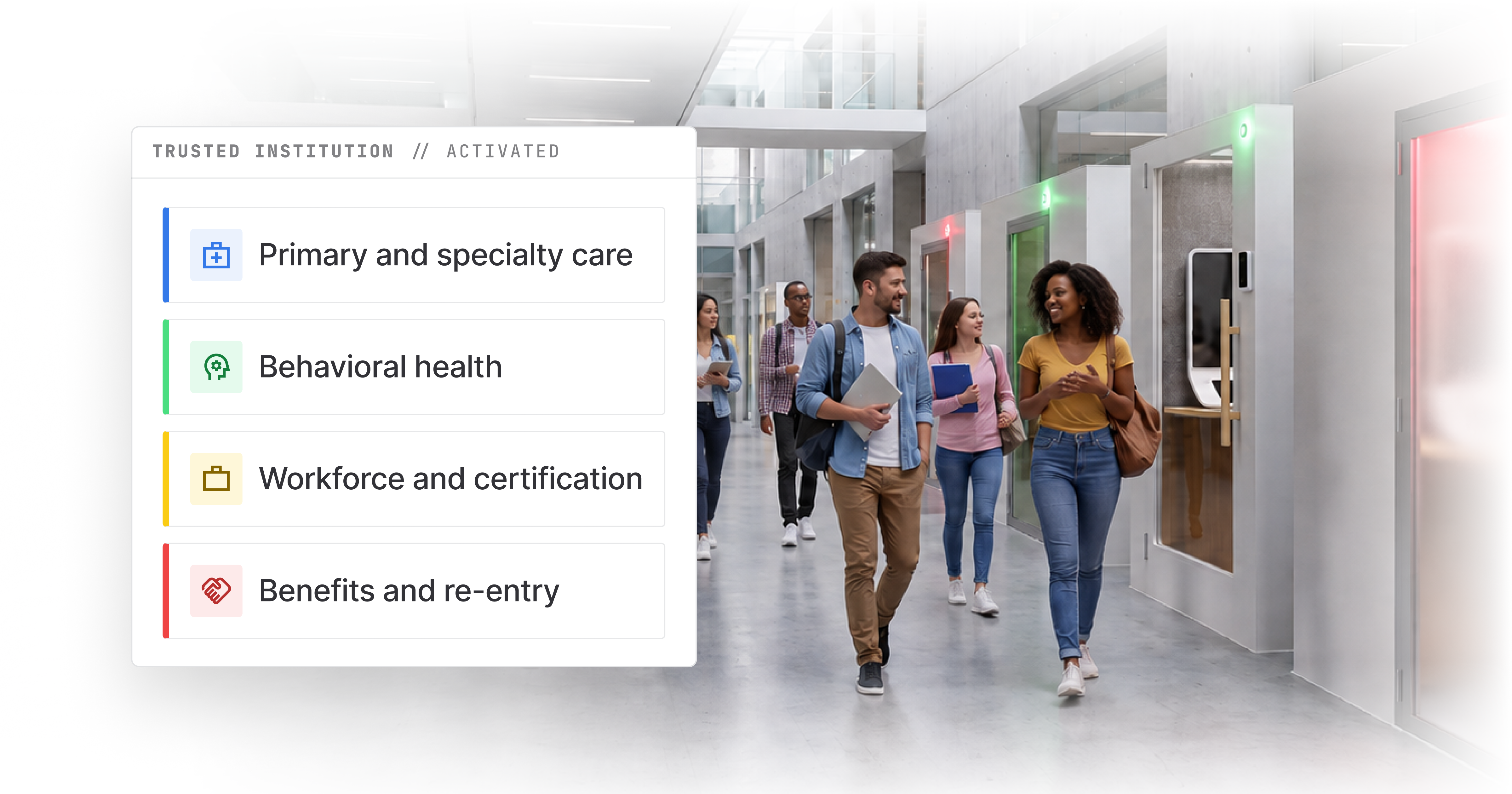
We live in an age of extremes. Technology is advancing at unprecedented speed, creating the potential for better outcomes across healthcare, education, and essential services. At the same time, America faces an unprecedented shortfall in access to reliable care and critical services.
The need is especially acute in rural America. More than 92 million Americans live in primary care shortage areas, while 137 million live in mental health shortage areas. In mental health shortage areas, just 27% of the need for care is being met. The gap is projected to widen, with the U.S. facing a shortage of up to 86,000 physicians by 2036.
Closing that gap does not always require building something new. Across America, libraries, schools, health facilities, community colleges, tribal centers, and other trusted public institutions already offer physical space, strong connectivity, geographic reach, and community trust. The opportunity is to put more of those assets to work.
Broadband made it possible to bring services to people instead of forcing people to travel for access. AI can extend the reach of scarce expertise much further, helping clinicians, educators, advisors, and other experts serve more people without requiring every service to exist locally. But that promise depends on the infrastructure people need to access it.
Access infrastructure closes the gap. It is the missing layer between powerful new digital services and the people who need them.
Connectivity is the foundation, not the finished product
America has spent decades investing tens of billions in broadband, including through programs like BEAD. That investment makes a world of difference. Without connectivity, none of what comes next is possible.
Those investments also created a distributed base of connected public assets. Access infrastructure can multiply their value by turning connected institutions into places where people can actually receive services.
AI can extend the reach and capability of remote services even further. A clinician can reach more patients. AI can help people navigate care, find the right provider, translate a conversation, or access expertise unavailable locally. Similar advances are emerging across education, workforce training, benefits, and other essential services.
But greater capability still depends on a practical way for people to reach and use it.
Consider mental healthcare. Remote therapy can connect someone with an available provider hundreds of miles away, while AI can support navigation, triage, translation, documentation, and other parts of the care experience. Home, however, is not always a place where someone can speak freely, and the key to successful service comes down to lifelike, high-fidelity presence which is next to impossible with a smartphone with a mediocre connection.
A phone and broadband connection do not help much if your children are in the next room, your partner can hear through the wall, or you are worried someone might walk in. The same problem applies to a medical appointment, job interview, benefits conversation, tutoring session, or any other high-stakes interaction.
Real access requires more than a network connection. People need privacy, high-quality interaction, accessibility, and a simple path to the right service.
That is what we mean by access infrastructure.
Trusted institutions can solve the missing middle
Rural health facilities, libraries, schools, community colleges, tribal institutions, and other local organizations already form a trusted physical network across America. Many have strong broadband and already serve as local access points for information, education, and support.
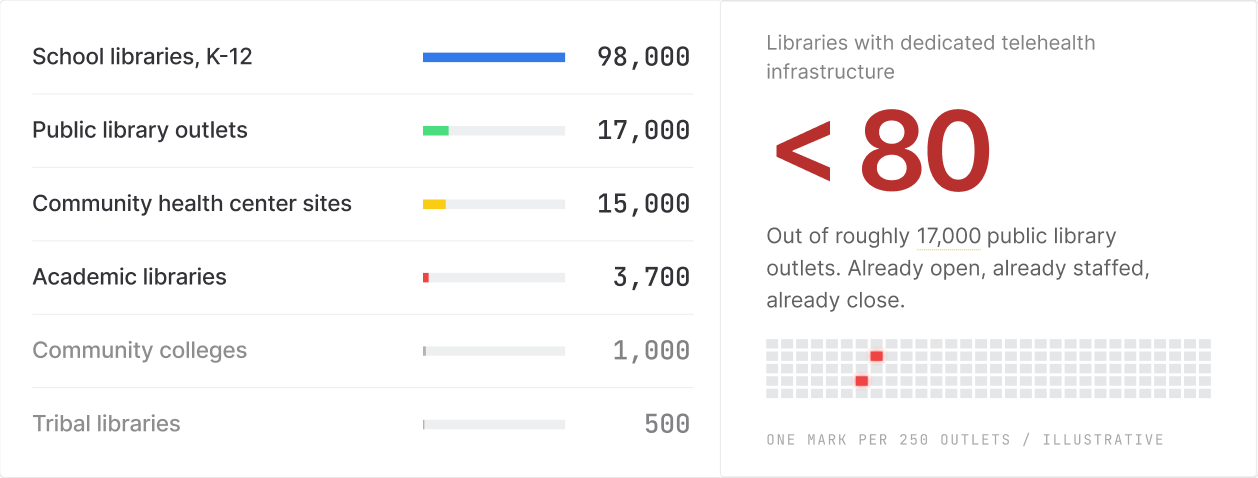 AI and remote services make that network far more valuable. A rural clinic can connect patients to specialists elsewhere. A school can connect students to training unavailable locally. A library can expand access to care, education, benefits, and other services without becoming the provider itself.
The need is growing. The Association of American Medical Colleges projects a shortage of up to 86,000 physicians by 2036, while roughly one in five physicians is already 65 or older. Communities cannot solve every shortage by recruiting more local professionals.
Technology can extend scarce expertise. Trusted institutions can provide the physical access layer people need to reach it.
The Rural Health Transformation Program gives states $50 billion over five years to expand rural healthcare, modernize technology, strengthen the workforce, and bring services closer to the people who need them. BEAD II guidance is expected soon, and could include billions of dollars for access infrastructure. In both programs, as well as dozens of existing state funding programs, trusted institutions can help extend the reach of those investments far beyond traditional healthcare facilities.
For directors facing obligation and deployment deadlines, existing assets offer another decisive advantage: speed. Equipping a trusted institution can require less construction, support multiple services through a single shared investment, and put funding to work faster than building and staffing a new facility from the ground up.
Access infrastructure has to clear four bars
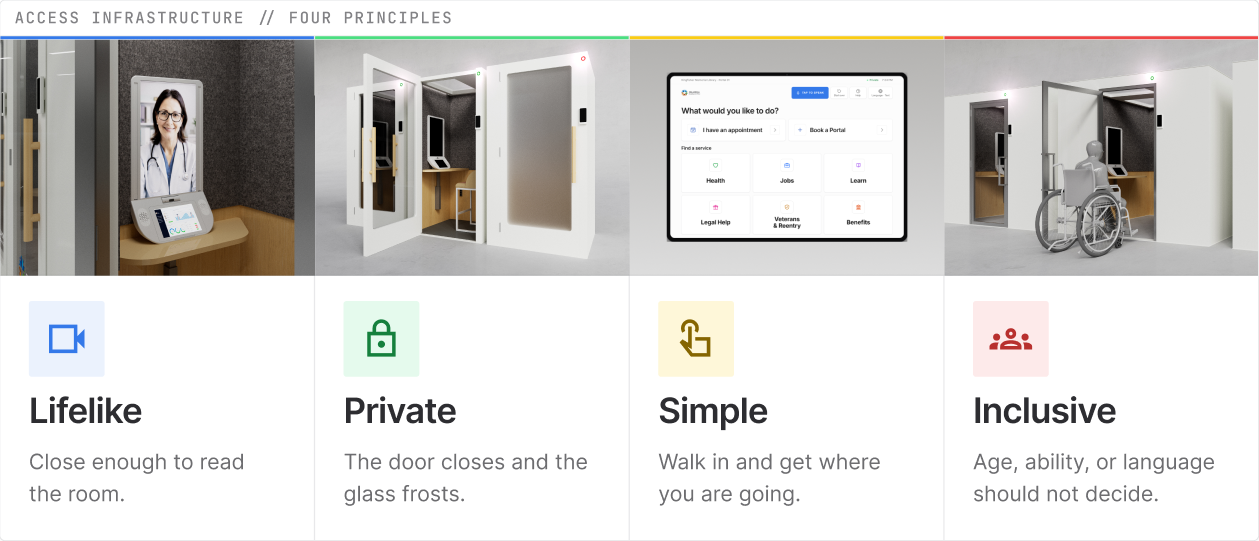
There is a profound difference between putting a tablet in a booth and creating infrastructure people can trust for an important appointment. Access infrastructure programs must clear four bars:
Lifelike. When a clinician is looking for subtle visual cues or someone is interviewing for a job, video and audio quality matter. The goal should be to come as close as possible to making two people feel as though they are sitting in the same room.
Private. Someone talking with a doctor or counselor should never have to wonder who else can hear them. Privacy must be the foundation, not a feature added later, so sensitive information goes only where it belongs.
Simple. A person should be able to walk in and reach the right service without becoming an expert in video conferencing software, telehealth platforms, or AI tools. The technology should make the path intuitive. Just as important, the host institution should not suddenly become responsible for operating an IT help desk.
Inclusive. Age, disability, language, or digital skill should not determine whether someone can use it. If public money is paying for the infrastructure, it should work for as many members of the public as possible.
The best access infrastructure makes complexity disappear. Someone should be able to walk in, receive the care or service they need, and walk out without ever having to think about the technology making it possible.
AI should meet the same standard: better services reaching more people, when and where they need them.
Oklahoma turned trusted institutions into access points
After years of investing in broadband deployment, the Oklahoma Broadband Office asked a different question: what more could already-connected public institutions deliver?
Instead of building an entirely new network of facilities, Oklahoma is leveraging existing community assets to create new points of care and opportunity.
Through its Community Access Portals program, Oklahoma is deploying 175 private, connected Portals across the state, starting with libraries.
The investment activates infrastructure already in place: connected facilities, physical space, trusted community relationships, and statewide reach. A library does not have to become a healthcare provider or workforce center. It gains a new way to connect people with services and expertise that are unavailable locally.
The same principle can extend to other trusted institutions as states consider where access infrastructure can deliver the greatest return.
Put more services within reach
For directors deploying RHTP, BEAD II, and other infrastructure funds, the opportunity is to rethink rural access around assets already in place. Start with the institutions communities trust, identify where people must travel for care and other essential services, and equip existing assets to bring more of those services closer to home.
AI can extend scarce expertise farther than ever before. Access infrastructure ensures AI can deliver what people need, when and where they need it.
Before funding a new facility, ask what an existing public asset could deliver with the right access infrastructure. It is time to put those institutions to work expanding access to care, education, and essential services.
Want to learn more about turning trusted institutions into points of care and opportunity?
Explore the Resiliency Playbook for practical guidance on identifying the right communities, selecting host institutions, and deploying access infrastructure at scale.
Make audit-ready your default state.
Post-award reporting, compliance oversight, and execution visibility in one structured system — built to hold as programs scale.