




Build a Resilient Multi-Modal Middle Mile Mesh (M5)
Strategic Brief
Broadband networks often fail at the exact moment communities need them most in emergent conditions because the middle mile infrastructure that connects 911 centers, hospitals, schools, cell towers, utilities, and local internet providers depend on too few routes, too few backup options, and too many shared failure points.
A Multi-Modal Middle Mile Mesh helps state leaders fix that problem.
This play gives states a practical roadmap to build hardened, carrier-neutral middle mile infrastructure that keeps critical services connected during storms, cyber incidents, fiber cuts, power outages, and other emergencies. Instead of relying on one fiber path or one provider, the network uses multiple routes and multiple technologies, including fiber, microwave, free-space optical links, satellite backup, and automated failover.
Investing in an M5 network helps state leaders:
- Identify the communities, 911 centers, hospitals, and public facilities most at risk
- Build resilient middle mile routes that do not fail together
- Create hardened network nodes at substations, emergency operations centers, and public safety sites
- Give rural ISPs access to more competitive backhaul
- Support NG911, emergency response, workforce development, and broadband reliability
- Prepare projects that can move quickly when BEAD II or other infrastructure funding becomes available
States get a stronger broadband backbone that supports public safety, lowers risk, improves rural connectivity, attracts private investment, creates skilled infrastructure jobs, and makes every future broadband dollar work harder.
The Opportunity
The Problem:
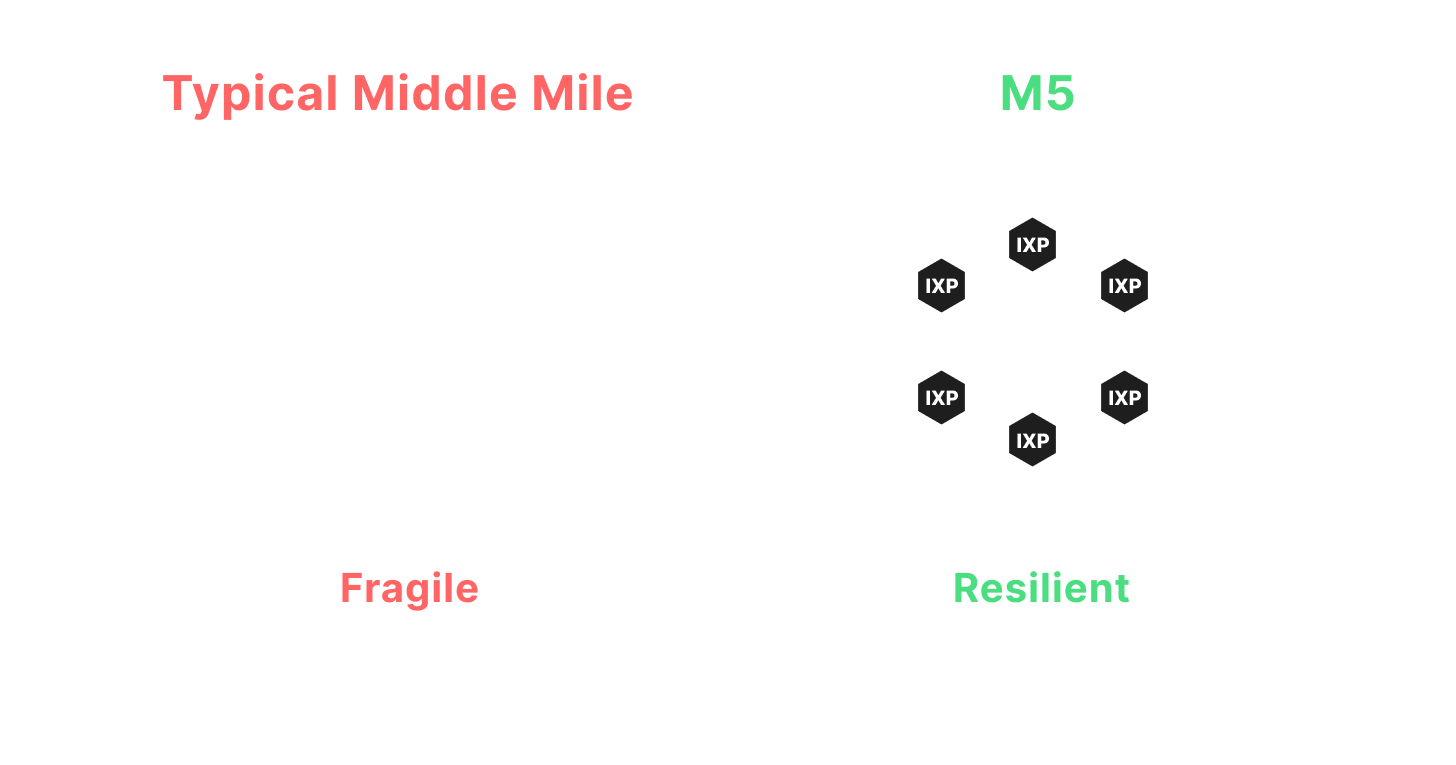
Most state broadband networks carry a hidden design flaw: fiber routes that share the same physical corridor. Aerial fiber strung on utility poles and buried fiber in conduit in the same roadway corridor look like two fully independent and unique routes. They are not. A flood, a landslide, a wildfire, or a road grader working in the wrong place takes both paths simultaneously. Hurricane Helene demonstrated this at scale in September 2024: 1,199,087 wireline subscribers went offline at peak; Asheville connectivity dropped to approximately 10 percent; 3,400 cell sites failed across the region. Aerial and buried fiber on shared rights-of-way failed together. Typhoon Mawar struck Guam in May 2023 with similar results: 70 percent of cell sites offline, 98 percent of residents without power, communications infrastructure designed for path diversity failing as a single unit. Also there are cases where a failure in one part of a network cascades to disable 911 services in areas with no direct exposure to a triggering event; the Federal Communications Commission documented 92 sympathetic multi-state outages in 2024 alone. Single-route middle mile does not fail only where the break occurs, but fails everywhere the route serves and everything that route serves: public safety answering points go dark, hospital communications fail, schools lose connectivity, and the public services communities depend on in a disaster are severed at precisely the moment they are needed most. The 92 outages reported by the FCC in 2024 may not capture the full scale and scope of how residents experienced interconnected failure across multiple sectors.
The Context:
Building program architecture for a resilient middle mile network is a prudent and defensible decision regardless of what federal programs are active or what guidance agencies have published. States that commission a vulnerability assessment, identify node sites, form a governance entity, and draft procurement language are positioned to move within weeks when funding becomes available — rather than months after the window opens. That planning work has value on its own terms: it gives state directors a rigorous map of where the infrastructure is most fragile, a legal structure ready to receive funds, and a program design that can be presented to legislators, utilities, and federal partners. Capital Projects Fund balances in several states remain available for capital-intensive infrastructure investment — and as of May 2026, CPF received a six-month extension for states that need additional time to deploy remaining funds. Any available state emergency preparedness, resilient infrastructure, or capital funding pool is a candidate for this work. States should not wait for a single perfect program to appear. The funding tools exist now; the architecture should be ready to meet them.
The Demand Signal:
States are already moving. North Carolina’s MCNC HERO project deployed $19 million in new middle mile fiber at approximately $91,000 per mile — a documented federal-match-stack model (59% NTIA, 14% philanthropic, 27% own-source) that other states can replicate. California’s Middle-Mile Broadband Initiative activated its first customer — the Bishop Paiute Tribe in Inyo County — in April 2026, validating the state-owned carrier-neutral model at $3.2 billion scale. The FCC’s March 2025 Notice of Proposed Rulemaking on 911 reliability (FCC-25-21) specifically proposes mandatory diverse-path circuit certification and inter-PSAP rerouting requirements — the precise capabilities M5 is designed to deliver. DOE GRIP has authorized $10.5 billion for grid resilience, with substation co-location of communications equipment eligible under Topics 1 and 2. FEMA Hazard Mitigation Grant Program funds are immediately available in states with active Helene disaster declarations — the fastest funding path for Southeast directors. The Taiwan government’s Matsu Islands architecture — activated after a 50-day outage caused by submarine cable cuts in 2023, then tested against four disruptions in January 2025 with zero service loss — provides the most complete operational proof of multi-modal failover at working scale. The demand is not theoretical. State directors are asking for a program design they can use.
The Play in Practice
Physical Infrastructure:
An M5 network consists of hardened nodes connected by physically diverse fiber routes, with multi-modal failover capability at every node.
Each node is a carrier-neutral interconnection facility co-located at an existing substation, emergency operations center, or public safety answering point. The core enclosure is a modular hardened shelter meeting MIL-STD-188-125-1 electromagnetic protection standards — minimum 80 dB attenuation at 1 GHz — which protects switching electronics against high-altitude electromagnetic pulse and severe RF interference events. The shelter houses fiber termination equipment, a carrier-neutral switching fabric supporting at minimum 8 peer connections at edge nodes and 50 or more at hub nodes, and a cybersecurity isolation module that separates network traffic from substation SCADA systems. Edge nodes at county EOCs and PSAPs anchor the NG911 Emergency Services IP Network routing layer; hub nodes at major substations and state capital facilities anchor the core resilient network. Every node operates for a minimum of 72 hours on autonomous backup power: a generator, battery storage, and where site conditions permit, solar supplementation.
Four transmission modes terminate at each hub node: fiber (primary, diverse-routed from at least two physically separated paths); licensed terrestrial microwave operating at 18 GHz or higher on point-to-point links to adjacent nodes; free-space optical links (FSO) capable of near-fiber throughput on clear-weather paths, each paired with a licensed RF backup link that activates automatically when atmospheric conditions degrade FSO performance; and multi-orbit satellite ground stations combining at minimum two LEO phased array terminals from different vendors with one GEO or MEO dish. Single-vendor satellite dependence is prohibited by procurement specification. States with existing statewide emergency interoperability tower networks — such as Mississippi’s MSWIN — have a natural FSO peering advantage: these towers are already sited for line-of-sight coverage, already hardened, and already managed by emergency management partners. Identifying state-owned tower infrastructure as candidate FSO peering points is a cost-reduction and partnership opportunity that should be part of every node siting analysis.
Fiber routes between nodes must be documented for physical separation across different rights-of-way, different drainage basins (watersheds — routes sharing a watershed are vulnerable to the same flood, landslide, or debris flow event simultaneously, making them functionally parallel even if they appear geographically separate), and where applicable different seismic or weather exposure zones. The goal is maximum feasible path diversity. Where terrain or geography — mountain corridors, river valleys, single-road rural areas — constrains routing options, the state broadband office reviews and approves the best available routing with documented justification. The standard is engineering sufficiency for the geography, not uniform compliance with a specification that terrain makes impossible. Route diversity documentation must demonstrate that alternatives were evaluated before any constrained routing is accepted.
Software-defined wide area networking (SD-WAN) operates as the control layer across all four modes. The SD-WAN separates the control plane from the data plane, monitors latency, jitter, and packet loss continuously across all active links, and reroutes traffic automatically within seconds at the network level. Intra-node switching fabric operates at sub-second speeds. Traffic priority policy elevates public safety and NG911 traffic under degraded conditions.
Operating / Governance Model:
M5 infrastructure is carrier-neutral wholesale-only. The entity that owns the infrastructure does not sell retail broadband services. Any qualified provider may connect to the switching fabric on published, non-discriminatory terms. Wholesale rates are set by an independent advisory committee, not by the network operator.
The ownership and operating entities must be legally distinct. The operator manages day-to-day operations, wholesale customer relationships, and maintenance; a separate board or advisory committee oversees rate-setting and open-access compliance. Change-of-control provisions in the infrastructure deed maintain open-access obligations through any ownership transfer. Quarterly compliance reporting is published to the state broadband office.
Wholesale revenue lines include: dark fiber indefeasible right of use (IRU) leasing; lit wavelength services; IXP port fees; satellite ground station hosting; and substation node colocation fees. Revenue modeling should target net-positive operations within three to five years of full-mesh activation in mid-state and large-state implementations.
Ownership Model 1 — State Broadband Authority / Nonprofit Operator Model
Description: The state broadband office or a state-chartered authority owns the physical infrastructure — fiber, nodes, and switching equipment. A nonprofit network operator manages wholesale services and customer relationships under a management agreement with performance benchmarks. The operator does not hold equity in the infrastructure and cannot compete at retail. Rate-setting authority rests with an independent advisory committee appointed by the state broadband director. This structure preserves state control over a strategic public asset while leveraging nonprofit operational expertise. The California MMBI tri-entity structure — CDT ownership, CENIC/GoldenStateNet administration, Caltrans construction, MMAC rate oversight — is the closest current U.S. analog.
Example: California Middle-Mile Broadband Initiative (CDT/CENIC/MMAC), California, 2022–present.
Ownership Model 2 — Electric Cooperative Consortium Model
Description: An association of electric cooperatives owns and operates the M5 nodes co-located at member substations, with fiber routes deployed along existing cooperative rights-of-way and pole lines. The cooperative consortium enters a carrier-neutral wholesale agreement committing to non-discriminatory access for all qualified providers. Governance follows the cooperative model: member cooperatives hold proportional board seats; major decisions require supermajority approval; retail broadband service by the consortium itself is prohibited in markets served by its wholesale customers. This model achieves the lowest per-mile construction costs (Alabama documented approximately $24,000 per mile) by leveraging existing cooperative infrastructure assets. DOE GRIP eligibility for substation co-location components reduces capital requirements.
Example: Alabama Fiber Utility Network (eight electric cooperatives, 3,400+ miles across 65 of 67 counties), Alabama, 2024–present.
Ownership Model 3 - Inter-Local Agency / Regional Authority Model
Description: Counties, municipalities, and tribal nations form a joint powers authority or inter-local agency under state enabling legislation. The authority owns the fiber routes and node infrastructure within its member jurisdictions; state-level coordination is handled through a master agreement with the state broadband office. This model is particularly effective in states where a single electric cooperative does not have statewide reach and where municipal broadband law restrictions apply to individual municipalities but not to multi-jurisdictional authorities. Governance distributes political accountability across member governments, reducing the incumbent-opposition framing risk. Rate-setting requires authority board approval, providing political accountability without state legislative action for each pricing decision.
Example: MCNC (NC Research Education Network) — a nonprofit serving as the state-designated open-access middle mile operator for North Carolina’s research, education, and government institutions, providing the governance template for a state-designated neutral operator model.
Implementation Approach
Commission a statewide middle mile vulnerability assessment
The state broadband office procures a geospatial analysis that maps every existing middle mile route in the state, documents which routes share rights-of-way, and identifies population centers, PSAPs, EOCs, and substations with single-route or no-route middle mile exposure. Communities are classified by risk tier: no path diversity, single route, partial resilient network coverage. The assessment applies FEMA-standard geographic exposure classifications — surge sheds for coastal areas and floodzone stages tied to FEMA Flood Insurance Rate Map designations — aligning the broadband office’s risk taxonomy with the hazard mitigation plans state emergency management agencies already maintain. This is not a novel framework; it is the same risk language emergency managers already speak. This work is fundable through existing broadband office planning budgets today. Its strategic value — a rigorous, defensible map of where the infrastructure is most fragile — positions the state well for future state and federal programs as they emerge, regardless of which specific programs are active at the time of procurement. Budget: $500,000–$2 million. Timeline: 3–6 months. Deliverable: a prioritized node siting map and route diversity deficit report that drives all subsequent procurement decisions.
Identify and prioritize node sites through co-location analysis
The broadband office, working with the state emergency management agency and electric utilities, scores candidate co-location sites against four criteria: population served within the node’s coverage radius; current single-route or no-route exposure; co-location cost savings versus greenfield construction (substation and PSAP co-location reduces site preparation and power costs by 20–40%); and geographic position for resilient network formation with adjacent nodes. PSAP-anchored nodes are prioritized for NG911 ESInet integration. Substation-anchored nodes are prioritized for DOE GRIP co-application. EOC-anchored nodes are prioritized for state emergency management coordination. States should also inventory their existing statewide emergency interoperability tower networks as candidate FSO peering points. These towers — Mississippi’s MSWIN is a named example, but nearly every state operates an equivalent statewide interoperability network — are already sited for line-of-sight coverage, already hardened to emergency communications standards, and already managed by the same emergency management partners M5 requires. Identifying them during node siting reduces FSO infrastructure costs and formalizes a partnership with emergency management agencies that strengthens both programs. Timeline: 2–4 months concurrent with or following the vulnerability assessment. Deliverable: a scored and ranked candidate node list with co-location agreements in principle from host facility operators.
Procure physically diverse fiber routes
The state broadband office issues a procurement with physical path diversity as the governing standard. Bidders must submit route documentation demonstrating that redundant paths travel through different rights-of-way and different drainage basins — routes that share the same physical corridor or watershed are vulnerable to the same failure event and do not constitute genuine path diversity regardless of how they are classified. Where terrain or geography constrains routing — mountain corridors, river valleys, single-road rural areas — bidders must document that alternative routing was evaluated and explain why the best available option was selected. The state broadband office reviews constrained-routing justifications before construction acceptance; the standard is maximum feasible path diversity for the geography, not a pass/fail threshold that terrain makes impossible. Procurement language benchmarks against MCNC HERO contract terms and incorporates electric utility co-deployment agreements to reduce per-mile cost. Timeline: 6–12 months for procurement cycle; 12–24 months for construction and acceptance. Budget reference: $91,000 per mile (MCNC HERO rural benchmark) to $400,000 per mile (California MMBI urban).

Unlock Your Free BEAD II Playbook
Benefits
Immediate
- The state knows exactly where the risk is highest and can direct every capital dollar toward the corridors most likely to fail in a disaster — the vulnerability assessment replaces guesswork with a defensible, geospatially verified risk map that drives every subsequent procurement decision.
- Priority PSAPs and EOCs have hardened, 72-hour autonomous communications capability — 911 stays answerable and emergency coordination continues even when the grid goes down, because the first node delivers that capability independently of any other network component.
- A procurement-ready governance structure is in place and can move quickly when funding becomes available — the legal entity, rate-setting framework, and open-access obligations are established before the funding window opens, not after.
- When a PSAP goes dark in a disaster, 911 calls can automatically reroute to a backup facility — the NG911 ESInet integration plan is delivered, funded, and ready to implement the capability North Carolina demonstrated operationally during Helene.
- Capital requirements for the first node cluster drop 20–40% before a single procurement dollar is committed — because co-location agreements with utilities and emergency facilities mean the land, power infrastructure, and facility access already exist.
Near Term
- Physically diverse fiber is in the ground and verified — the state has its first routes with documented independent paths, and the construction record proves that path diversity was achieved, not just declared.
- The first hardened node is operational: a PSAP or EOC has 72-hour autonomous communications capability, the resilient network architecture has a working proof point, and state directors have something tangible to show legislators, federal partners, and community stakeholders.
- SD-WAN orchestration is live and the first quarterly failover drill is documented — the network has demonstrated its failover behavior under controlled conditions, establishing the baseline for the annual resilience reporting series.
- Co-location agreements with electric utilities and emergency management agencies are formalized and on record, positioning the state for future funding from complementary programs as they become available.
Strategic
- Communities across the state have communications infrastructure that survives the disasters Helene and Mawar demonstrated — catastrophic failure becomes highly improbable rather than near-certain for covered regions, because physically diverse paths and multiple transmission modes fail independently rather than simultaneously.
- Rural ISPs have access to competitively priced backhaul for the first time — transit costs drop 40%+ where comparable carrier-neutral middle mile has been deployed, and that reduction creates downstream pressure on consumer prices in markets that previously had no wholesale alternative.
- Every PSAP in the state can automatically reroute 911 calls when a primary facility goes dark — the capability North Carolina demonstrated ad hoc during Helene is now a permanent, statewide guarantee built into the network architecture.
- The network pays its own way — wholesale revenue from dark fiber, lit wavelength, and colocation reaches net-positive operations within 3–5 years, reducing long-term state budget exposure and eliminating the need for recurring general fund support.
- The state broadband office is the permanent center of gravity for communications resilience — the institution other agencies call when infrastructure fails, not just when grants need administering.
- Resilient backbone infrastructure attracts private investment in low-latency applications — data centers, cloud providers, edge computing, distributed manufacturing, precision agriculture, and telemedicine all require the latency and reliability characteristics M5 delivers, and states that have built the backbone are the ones that get the call.
- The network generates real free cash flow back to the state treasury, not just economic multiplier effects. Stokab, Stockholm’s carrier-neutral dark fiber operator, generates approximately €25 million in annual income on €80 million in turnover after 30 years of operation without public subsidy — the documented benchmark for what a well-governed carrier-neutral wholesale network can return.
Cascading Effects
First-Order Effects
Physically diverse fiber routes eliminate the parallel-path vulnerability that caused simultaneous aerial/buried fiber failure during Helene and comparable events
Multi-modal failover at hub nodes ensures that flood, fire, physical cut, and electromagnetic interference each fail differently — no single event disables all modes simultaneously
SD-WAN automated rerouting delivers rapid network-level path switching, preserving real-time voice and video quality for 911 and emergency coordination during partial network degradation; intra-node switching operates at sub-50-millisecond speeds
72-hour autonomous backup power at every node keeps the NG911 routing layer operational through extended grid outages without generator resupply
EMP shielding at MIL-STD-188-125-1 standard protects switching electronics against high-altitude electromagnetic pulse — the threat that has no weather warning
Carrier-neutral switching fabric creates a new interconnection market at each node location: providers that could not previously afford to build to rural markets can now connect to the wholesale backbone at published rates
NG911 ESInet integration enables automatic inter-PSAP call rerouting when a primary PSAP is disabled — the capability the FCC documented as the single strongest U.S. demonstration of NG911 resilience in its March 2025 NPRM
M5 backbone infrastructure hardens every dependent system simultaneously: NG911 routing, utility SCADA supervision, emergency management coordination, and ISP backhaul all run over the same physically diverse, multi-modal network. A single investment in resilient infrastructure produces compounding returns as more critical services migrate to the hardened backbone. The Matsu Islands implementation demonstrated this compounding effect: after the 2023 cable cut caused a 50-day outage, the government invested in engineered multi-modal failover; in January 2025, four disruptions in a single month produced zero service loss.
Second-Order Effects
Affordability: Rural ISPs currently pay 10–11 cents per Mbps for transit — a 2–2.5× premium over urban data center locations. Carrier-neutral M5 nodes open rural corridors to a competitive wholesale transit market for the first time. ISPs connecting to the wholesale fabric at published rates can reduce backhaul costs, and in competitive markets that reduction flows to consumer pricing. Alabama’s Fiber Utility Network documented the mechanism: cooperative-owned middle mile gave small ISPs access to a competitive wholesale market that did not previously exist in rural Alabama.
Competition: The carrier-neutral switching fabric at each M5 node functions as a micro-IXP — a local interconnection point where multiple providers can exchange traffic without routing through a distant hub. This creates the structural conditions for ISP entry into rural and suburban markets where backhaul cost previously made service uneconomical. UTOPIA Fiber’s model — 19 competing ISPs on shared open-access infrastructure — is the documented outcome of this architectural choice, scaled to municipal level. M5 extends that dynamic to the state backbone.
Economic Development: EPB Chattanooga’s smart grid and fiber network generated a documented $5.3 billion in cumulative economic benefit through 2025, including 10,400 jobs and reduced outage costs. The M5 mechanism is similar but statewide: low-latency, high-reliability backbone infrastructure is the site selection criterion for data centers, cloud infrastructure providers, and distributed manufacturing. Stokab’s Stockholm model demonstrates both the revenue story and the economic development story simultaneously: 100+ operators on carrier-neutral dark fiber infrastructure generating approximately €25 million annual income — free cash flow that flows back to the public entity that built the network — while Sweden reached 97%+ fiber-to-the-premises coverage nationally. The first state to build a complete M5 establishes itself as a referenceable proof point for subsequent private investment in the low-latency applications — edge computing, distributed AI inference, precision agriculture, telemedicine — that resilient backbone infrastructure enables.
Workforce Development: M5 construction requires fiber installation crews, licensed RF engineers for microwave link design, FSO installers, satellite ground station technicians, and SD-WAN engineers — a skill stack that spans the electrical and telecommunications trades. Construction-phase employment creates the direct training pipeline; the ongoing operations phase creates a permanent, specialized technical workforce operating hardened state communications infrastructure. States that embed M5 construction into registered apprenticeship programs produce workers with multi-modal telecommunications skills that transfer to last-mile deployment, utility telecommunications, and private sector network operations.
Unlock Your Free BEAD II Playbook
Risks & Mitigations
Unlock Your Free BEAD II Playbook
Real-World Case Files
Documented incidents and programs providing cost benchmarks, failure analysis, and proven implementation models.
MCNC / NCREN + Hurricane Helene Parallel-Path Lesson
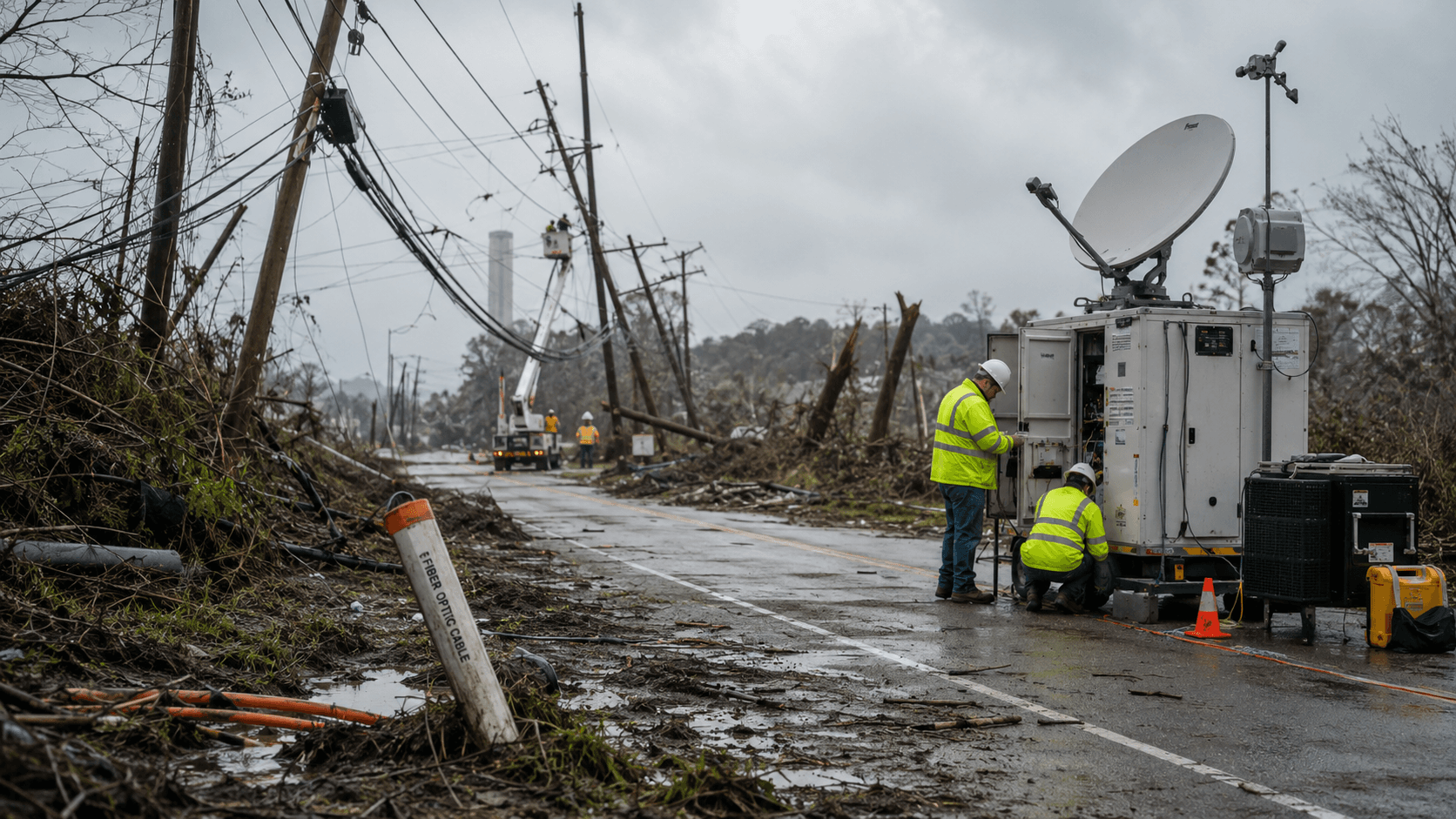
MCNC operates the North Carolina Research and Education Network (NCREN), a 4,500+-route-mile open-access middle mile backbone serving education, research, libraries, health care, public safety, and other community anchor institutions across North Carolina. When Hurricane Helene struck western North Carolina in September 2024, MCNC lost all network to the west when the three main fiber paths into the Asheville/Hendersonville region failed simultaneously. A catastrophic regional event, causing three engineered paths into a single region failing at once is empirical motivation for M5's multi-modal requirement, in addition to physically diverse and verified fiber paths.
- 4,536+ route miles of open-access middle mile serving NC research, education, healthcare, and government institutions
- 99.99% uptime under normal operating conditions
- HERO expansion: $11.2M NTIA award for an ~$19M total project; 209 added route miles; 11 counties in central and southeastern NC; HERO service area has 16,000+ unserved and 12,000+ underserved housing units
- Hurricane Helene (Sept. 2024): all three main fiber paths into the Asheville/Hendersonville region failed simultaneously; limited service restored within ~24 hours with help from regional partner ERC Broadband; two of the three main paths repaired within a week, including placement of 9.5 miles of temporary fiber on an alternate path around an impassable DOT road
Source: MCNC HERO Project page, mcnc.org/knowledge-center/hero-project (accessed April 2026); Telecompetitor, “MCNC to Kick Off Middle-Mile Broadband Expansion Project With $19M in Funds,” August 2024; NTIA Internet for All HERO award documentation, June 2023, broadbandusa.ntia.gov.
Relevance: MCNC provides the closest U.S. analog to the M5 governance model (nonprofit state-designated neutral operator, open-access wholesale, multi-source match stack) and the best-documented per-mile cost benchmark for rural middle mile construction. The Helene parallel-path failure directly motivates M5’s core procurement requirement.
Taiwan Matsu Islands Multi-Modal Failover Architecture
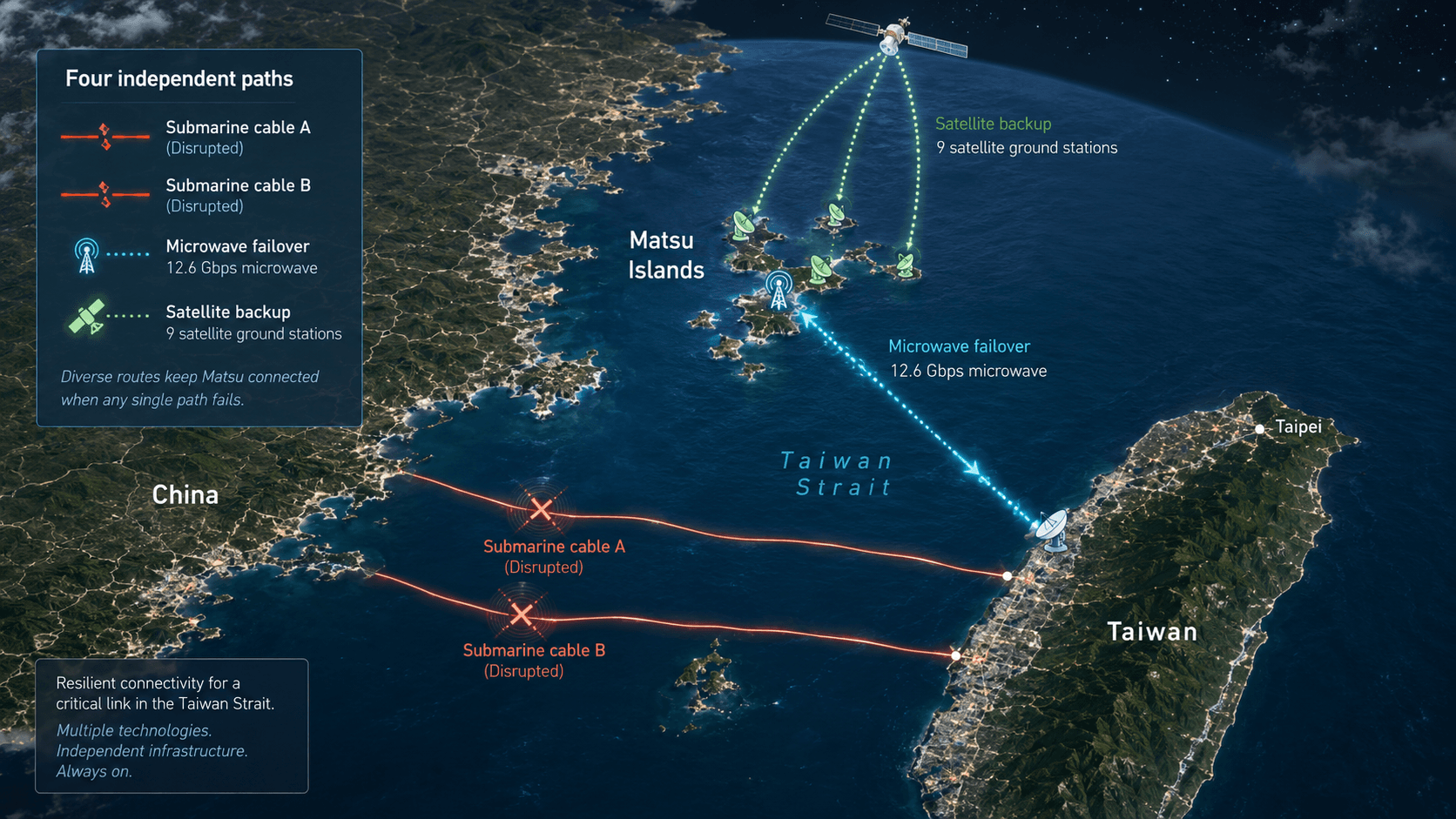
In February 2023, two submarine cables connecting the Matsu Islands to Taiwan were severed and the islands' 12,000+ residents discovered that the fallback microwave link had been sized far below normal demand. As a result, connectivity degraded for roughly 50 days, until the first cable was repaired at the end of March. The lesson Taiwan's Ministry of Digital Affairs (MODA) learned was not that backup was missing, but that it had not been engineered to carry real load.In response, MODA built a more suitable solution. It upgraded the microwave link to 12.6 Gbps ( Matsu's peak demand is around 9.5 Gbps), so the backup could accommodate network demands. It was also paired with nine satellite dishes (eight LEO, one MEO). The design principle shifted to the principle of “backup and backup.” That architecture was tested in January and February 2025, when the Matsu cables were severed again, including a complete break of both cables. This time residents faced far less impact: the microwave and satellite paths carried the load and service held. The 2023 collapse and the 2025 continuity are the same islands under two different design states — the first showing the absence of a properly engineered failover, the second showing engineered multi-modal failover operating as designed.
- 2023: 50-day service outage following dual cable cuts; microwave backup insufficient for demand
- 2025: Both cables to Matsu were severed with minimal service loss under engineered multi-modal architecture
- Microwave link capacity: 12.6 Gbps (versus 9.5 Gbps peak demand)
- Satellite terminals: nine, providing geographically distributed last-resort failover at key government locations
- Failover activation time after 2025 disruptions: microwave active within 1 hour of cable disruption
Source: Taiwan Ministry of Digital Affairs press release, moda.gov.tw, February 2025; Foreign Policy, “Taiwan’s Matsu Islands Survived Its Communications Test,” January 2025; Taipei Times, “Matsu telecom cuts repaired as connectivity restored,” January 23, 2025; The Diplomat, “What Matsu’s Internet Outage Reveals About Taiwan’s Vulnerabilities,” April 2023.
Relevance: Matsu is the only documented implementation of engineered multi-modal failover — fiber, microwave, and satellite operating as designed peers with automatic switchover — that has been tested against real multi-disruption events. It is the proof point for M5’s core mechanism: that different failure modes fail differently, and an engineered multi-modal architecture survives events that disable any single mode.
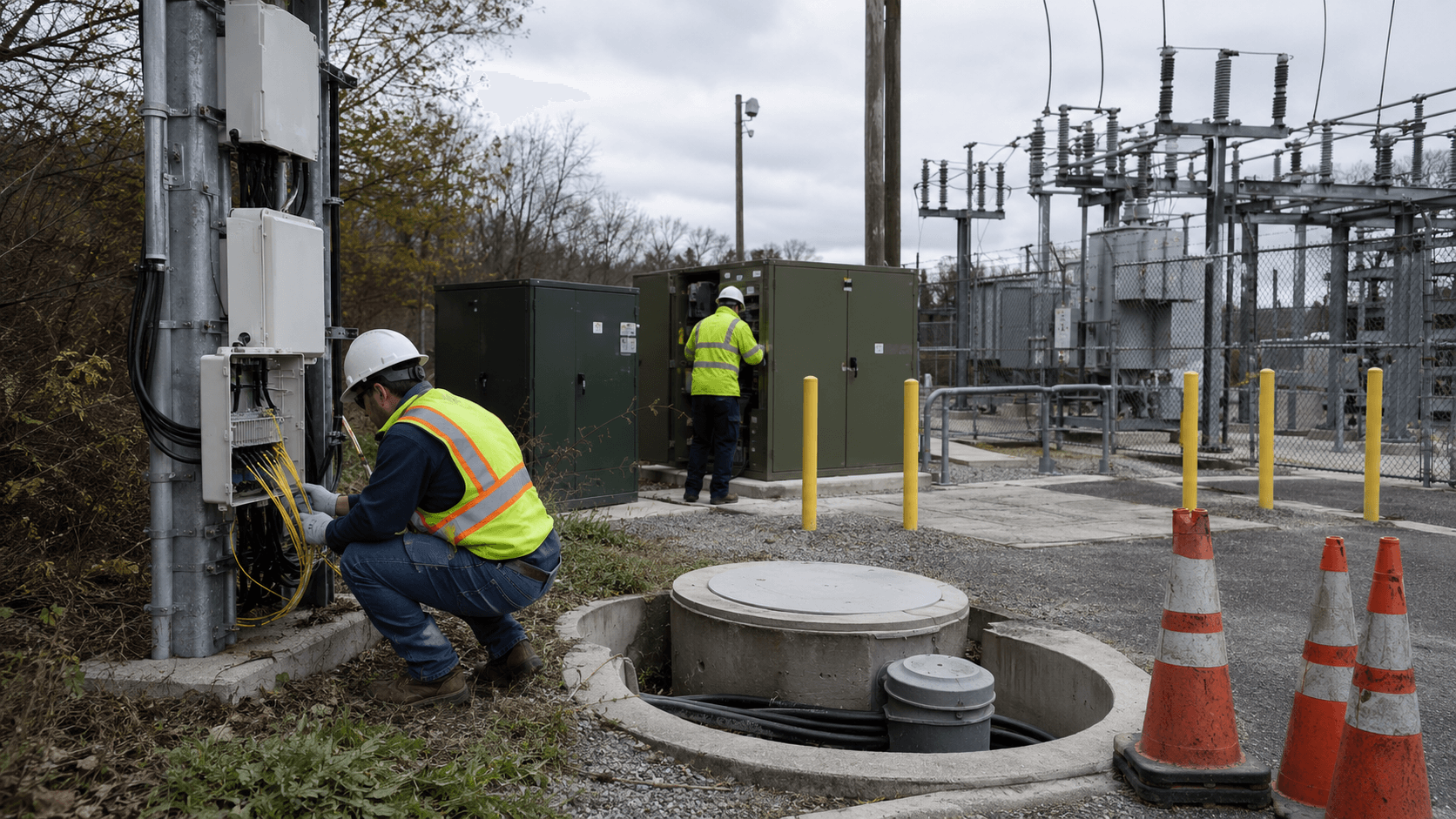
EPB Chattanooga — Smart Grid and Fiber Convergence at Substations
EPB, Chattanooga’s municipal electric utility, deployed 9,000 miles of fiber alongside its electric distribution system, integrating smart grid controls with a carrier-grade fiber network serving residential and commercial customers. Total capital: approximately $390 million ($229M bonds + $111M federal smart-grid grant + $50M electric-division loan). The smart grid fiber enables automated switch rerouting that prevented outages entirely for 44,000 of 106,000 affected customers almost instantaneously of an April 2020 tornado without crew deployment. Cumulative documented economic benefit reached $5.3 billion through 2025, including an estimated 10,400 jobs. Outage minutes dropped down to an annual average of approximately 59% per the 2025 Lobo study. EPB’s substation co-location model — fiber and grid controls sharing hardened substation infrastructure — is the governance template M5 replicates for communications nodes at electric substations.
- 9,000 miles of fiber deployed across 600-square-mile service area
- $396M total capital; $5.3B cumulative economic benefit (Bento Lobo, 2025)
- Approximately 10,400 jobs created or retained (Bento Lobo, 2025)
- ~59% annual average reduction in outage minutes; 417+ million outage minutes prevented since 2011 (Bento Lobo, 2025)
- April 2020 tornado: 44,000 of 106,000 affected customers prevented from losing power almost instantaneously via automated smart-switch rerouting while the remaining 62,000 required crew deployment.
- 25G PON commercial service launched 2022; first U.S. commercial gigabit-to-home provider (2010)
Source: Bento Lobo studies (multiple, 2011–2025), University of Tennessee at Chattanooga; The Utility Expo, “EPB’s Smart Grid at 15,” March 2025; Nokia Blog, “EPB Fiber Optics: The Network That Changed Chattanooga,” November 2024; Cities Today, “How Chattanooga used its smart grid to speed up storm recovery,” February 2021.
Relevance: EPB demonstrates that substation co-location of fiber and grid controls is operationally proven at city scale and produces resilience outcomes (automated storm recovery) and economic impacts ($5.3B) that directly parallel M5’s value proposition. The 19-state municipal broadband restriction it surfaces is the primary governance constraint for M5 replication.
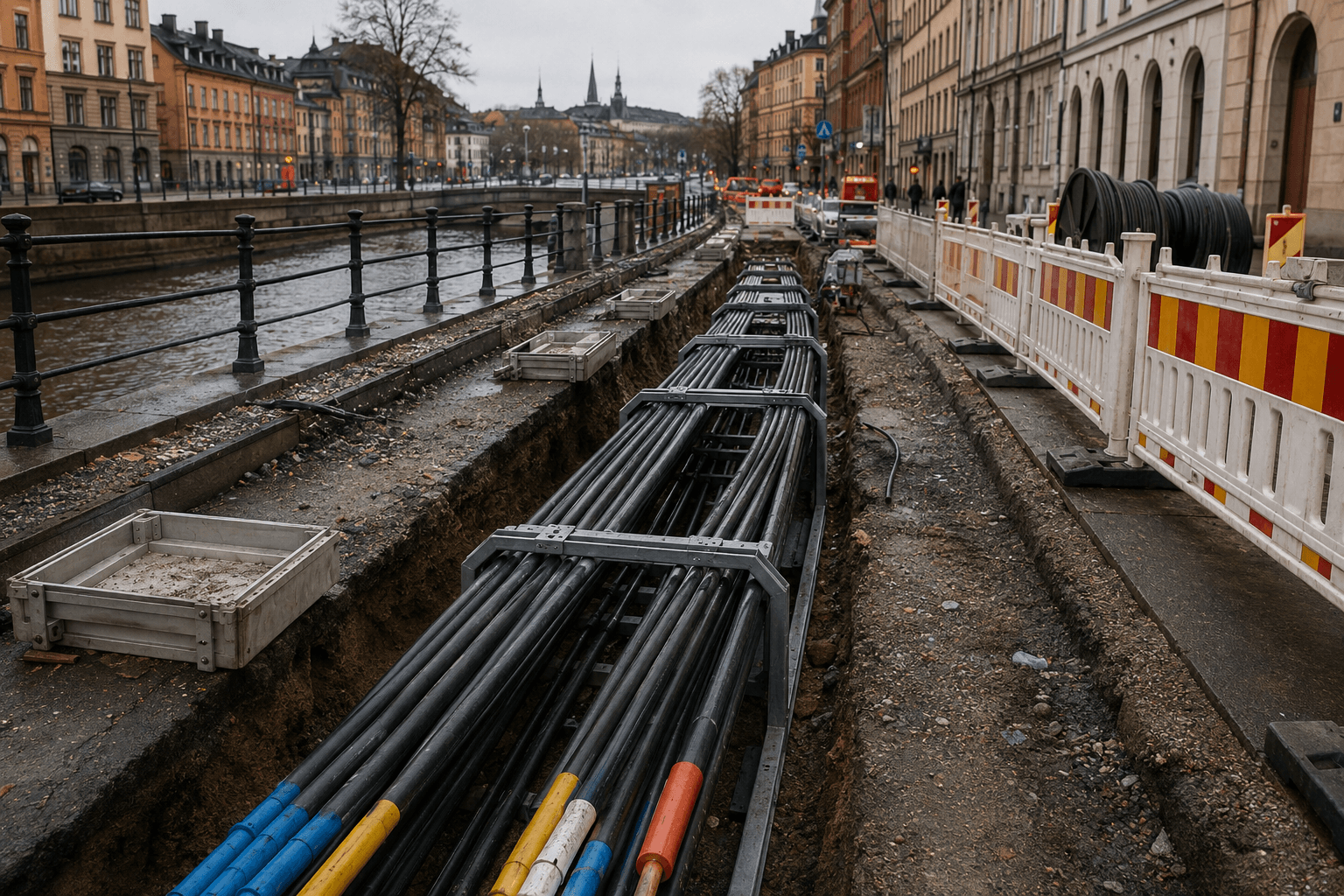
North Carolina NG911 ESInet — Hurricane Helene Inter-PSAP Rerouting
During Hurricane Helene (September 2024), NG911 infrastructure in North Carolina automatically rerouted 911 calls from storm-impacted western North Carolina counties to eastern North Carolina PSAPs, maintaining answering capability when the affected PSAPs were unreachable. FCC-25-21 (March 2025) cited the NC Helene ESInet rerouting as evidence supporting proposed reliability and interoperability rules for NG911 networks.The North Carolina 911 Board confirmed that had legacy analog 911 infrastructure remained in place, the rerouted calls would not have been answered. The event documents both the capability M5 is designed to institutionalize and the consequence of not having it: communities unsupported by NG911 with inter-PSAP routing created a vacuum where calls went unanswered during the storm.The NC 911 Board subsequently received a national NG911 award for its presentation "Validating the Implementation of NG911: 911's Response to Hurricane Helene in North Carolina," and in February 2026 completed a first-of-its-kind cross-state live 911 call routing exercise with Washington D.C., explicitly building on the Helene proof of concept and positioning North Carolina as the national model for interstate NG911 interoperability.
- 911 calls from storm-impacted western NC counties successfully rerouted to eastern NC PSAPs
- FCC-25-21 (March 2025) cited the NC Helene ESInet rerouting as evidence supporting proposed reliability and interoperability rules for NG911 networks.
- (March 2025)
- NC 911 Board: legacy analog infrastructure would not have supported rerouting
- Demonstrated at-scale, under-disaster conditions — not a test environment
Source: FCC NPRM FCC-25-21, March 2025, fcc.gov; FCC 25-21, Facilitating Implementation of Next Generation 911 Services (NG911); Improving 911 Reliability, Further Notice of Proposed Rulemaking, PS Docket Nos. 21-479 and 13-75, adopted March 27, 2025, released March 28, 2025; StateScoop, “How North Carolina 911 routing survived Hurricane Helene,” October 21, 2024; FirstNet, “Supporting Public Safety After Hurricane Helene,” October 2024.
Relevance: North Carolina’s Helene response directly demonstrates the operational capability M5’s NG911 ESInet integration is designed to institutionalize statewide. It is one of the most impactful U.S. instances of inter-PSAP call rerouting under a declared major disaster and provides the FCC’s own evidentiary basis for the proposed NG911 reliability rulemaking M5 architecture satisfies.
Have More Questions?