
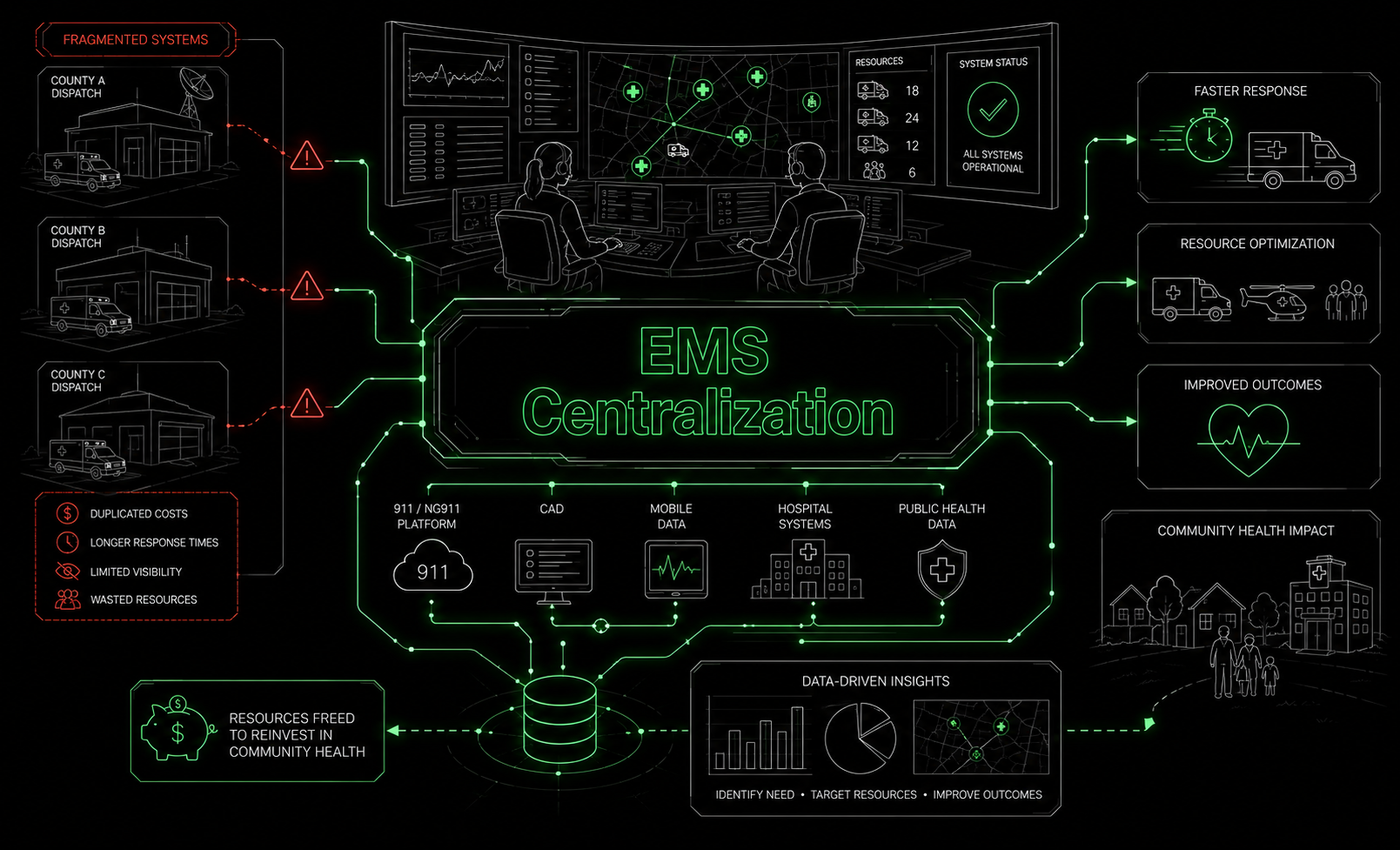
EMS Centralization
The consolidation of emergency medical services dispatch, coordination, and resource management under a single platform or authority to improve efficiency, reduce response times, and pool resources across fragmented local EMS systems. Oklahoma's RHTP allocates $4.5 million to procure a centralized EMS coordination platform, addressing a system where limited coordination currently occupies up to 50% of community emergency management resources for non-emergencies. EMS centralization is part of a broader national movement to modernize emergency response infrastructure, parallel to NG911 (Next Generation 911) modernization funded through federal infrastructure legislation. Fragmented EMS systems are expensive and inefficient, and their improvement frees resources that can be redirected to community health needs. For telehealth infrastructure, a more efficient EMS system reduces the pressure that emergency calls place on rural health systems, creating space for the preventive and chronic care management that telehealth supports. EMS centralization also creates data infrastructure — dispatch and response data — that can be integrated with health data systems to identify high-need populations for proactive telehealth outreach.
All glossary terms
Back to index- Administrative Expenses
- Advanced Communications Networks
- Aerial Deployment
- Aerial Fiber
- Affordable Connectivity Program
- AI Edge Node
- AI-Supportive Telecommunications Infrastructure
- Alternative Connection Paths (Network Resilience)
- American Rescue Plan Act
- Annual Outage Allowance
- Application Model
- Area Challenge Module
- Assassin's Maces
- Assassin's Maces (杀手锏, Shashoujian)
- Asymmetric
- Autonomous Recovery
- Average Revenue Per User
- BABA Whitelist Compliant Equipment
- Backbone
- Bandwidth
- BEAD Grant Cybersecurity Requirements
- BEAD Supporting Funds
- BEAD Timelines
- Benefit of the Bargain Analysis
- Bit
- Blended Domains
- Border Gateway Protocol
- Broadband
- Broadband Audit
- Broadband Deployment Accuracy and Technological Availability Act
- Broadband Deployment Accuracy and Technological Availability Act Maps
- Broadband Equity, Access, and Deployment II
- Broadband Equity, Access and Deployment Program
- Broadband Feasibility Study
- Broadband Initiatives Program
- Broadband Serviceable Locations
- Broadband Technology Opportunities Program
- Budget Period
- Build America Buy America
- Bulk Fabric Challenge
- Buried Fiber
- Cable Internet
- Capital Expenditures
- Capital Projects Program
- Capital Structure
- CareerTech
- Carrier-Neutral Infrastructure
- Cascading Failure
- Census Block
- Census Block Group
- Certified Community Behavioral Health Clinic
- Challenge Process
- Clawback Provisions
- Closed-Loop Referral Platform
- Coaxial Cable
- Common Equity Stock
- Commonly Accepted Standards (Telecom Context)
- Communications Act of 1934
- Community Anchor Institution
- Community Development Financial Institution
- Community Health Worker
- Community Reinvestment Act
- Compliance Automation Platform
- Conduit Financing
- Conduit Systems and Manholes
- Connect America Fund
- Connecting Minority Communities Pilot Program
- Connectivity Profile
- Consolidated Appropriations Act of 2021
- Content Provider
- Contested Logistics
- Cooperative
- Critical Access Hospital
- Customer Premises Equipment
- Cyber and Electromagnetic Attacks
- Cybersecurity for Emergency Communications
- Cybersecurity Resilience
- Data Packet
- Davis-Bacon Act (for BEAD)
- Debt/EBITDA
- Debt-Service Ratio Coverage
- Demand Point Passed
- Digital Canyon
- Digital Contested Logistics
- Digital Equity
- Digital Equity Act Programs
- Digital Infrastructure
- Digital Infrastructure as a Strategic Target
- Digital Sovereignty
- Digital Subscriber Line
- Digital Twin Infrastructure Mapping
- Direct Network Interconnection (Edge AI Context)
- Earnings Before Interest Taxes Depreciation and Amortization
- Economic Development Incentive
- Edge Computing Readiness
- Electromagnetic Pulse Resistant Enclosures
- Electronic Health Record
- Eligible Community Anchor Institution
- Eligible Entity
- Emergency Communications Center
- Emergency Services IP Network
- Enterprise Value
- Equity
- Ethernet Cable
- Fabric
- False Confidence Paradox
- FCC Registration Number
- Feasibility Study
- Federal Communications Commission
- Federal Facilities Connectivity Requirements
- Federally Qualified Health Center
- Fiber
- Fiber-to-the-Curb
- Fiber-to-the-Home
- Fiber to the home/premises/curb/node
- Fiber-to-the-Node
- Fiber-to-the-Premises
- Final Proposal
- Final Proposal Submission
- Five-Year Action Plan
- Force Majeure Documentation Standard
- Formula Grant
- Future Computing Technologies
- Incumbent and Competitive Local Exchange Carriers
- Indefeasible Right of Use
- Indian Tribe
- Industrial Revenue Bonds
- Infrastructure Hardening ROI
- Infrastructure Investment & Jobs Act
- Initial Funding Availability
- Initial Proposal
- In-kind Matching Funds
- In-Line Amplifier Facilities
- Interconnectivity
- Internet Exchange Facility
- Internet Exchange Point
- Internet Protocol
- Internet Service Provider
- Interoperability
- Irrevocable Standby Letter of Credit for BEAD Grants
- Make Ready Work
- Match Capital
- Matching Funds for BEAD Grants
- Matching Requirements for Infrastructure Grants
- Medicaid
- Medication-Assisted Treatment
- Mezzanine Debt
- Micro Data Center
- Middle Mile
- Millimeter Wave
- Mission-Critical Ruggedization
- Mobile
- Mobile Wireless Communications Infrastructure on Educational Facilities
- Multi-Modality
- Multi-Modal Network
- Multiple Dwelling Unit
- Multiple Dwelling Unit Challenge Module
- Municipal Bond
- Packet Loss
- Peering and Transit Agreements
- Performance Bonds for BEAD Grants
- Performance Test & Survey
- Physical Layer Attack
- Point to Point
- Post-Quantum Cryptography
- Preferred Equity
- Preparedness and Resilience
- Presidential Fitness Test / School Wellness
- Priority Broadband Project
- Private Activity Bonds
- Program of All-Inclusive Care for the Elderly
- Project Finance
- Provider Collaborative Network
- Public-Private Partnerships
- Public Safety Answering Point
- Public Utility Company
- ReConnect Loan and Grant Program
- Reliability
- Reliable Broadband Service
- Remaining Amounts
- Remote Patient Monitoring
- Request for Initial Planning Funds
- Resilient Digital Infrastructure
- Resilient Network Architecture
- Revenue Bond
- Revolving Credit Line
- Route Server
- Rural Digital Opportunity Fund
- Rural Electrical Cooperatives
- Rural Health Transformation Program
- Rural Residency Program
- Rural Utility Service
- Satellite Internet
- Secondary Addresses
- Secured Debt
- Security
- Senior Debt
- Service Continuity During Compromise
- Simple Agreement for Future Equity
- Space Dominance and Exploration Infrastructure
- Special Award Conditions
- Speed
- Speed Test Module
- State
- State Plan Amendment
- Strategic (High Altitude) EMP
- Strategic Telecommunications Infrastructure
- Subgrantee Selection
- Subgrantee/Subrecipient
- Submarine Cable Landing Station (Carrier-Neutral)
- Subordinated Debt
- Subsidiarity
- Substance Use Disorder
- SUCCESS for BEAD Act
- Supply Chain Weaknesses
- Symmetric
- Tactical (Close Range) EMP
- Take Rate
- Taxable Debt
- Tax-Exempt Debt
- Telecommunications Act of 1996
- Telecommunications Backbone Hardening
- Telehealth
- Telehealth Portal / Kiosk
- The Good. The BEAD. The Ugly.
- Three-Legged Stool Model
- Transmission Diversity
- Tribal Broadband Connectivity Program
- Tribal Data Sovereignty
- Tribal Government
- Tribal Land
- Trust Land